Am Freitag Dem Oder Den

Der, Die, Das: Your German Article Adventure Starts Here!
Learning German can be a fun challenge. One of the first hurdles you'll encounter is mastering the definite articles: der, die, and das.
These little words are like tiny flags. They tell you the gender of a noun. Think of it as each noun having a secret identity!
Don't worry, we'll break it down step-by-step. Soon you'll be navigating German grammar like a pro.
What are Articles, Anyway?
In English, we have "the" and "a/an". These are called articles. They come before nouns. Nouns are people, places, things, or ideas.
For example, "the cat" or "a book." These articles specify or introduce the noun.
German also uses articles. But things get a bit more interesting. German has three definite articles instead of one.
The Three Musketeers: Der, Die, Das
The German definite articles are: der, die, and das. Each article corresponds to a grammatical gender. These genders are masculine, feminine, and neuter.
Der is the masculine article. Die is the feminine article. Das is the neuter article.
Think of them as labels. Each noun has one specific label.
"Am Freitag" Explained
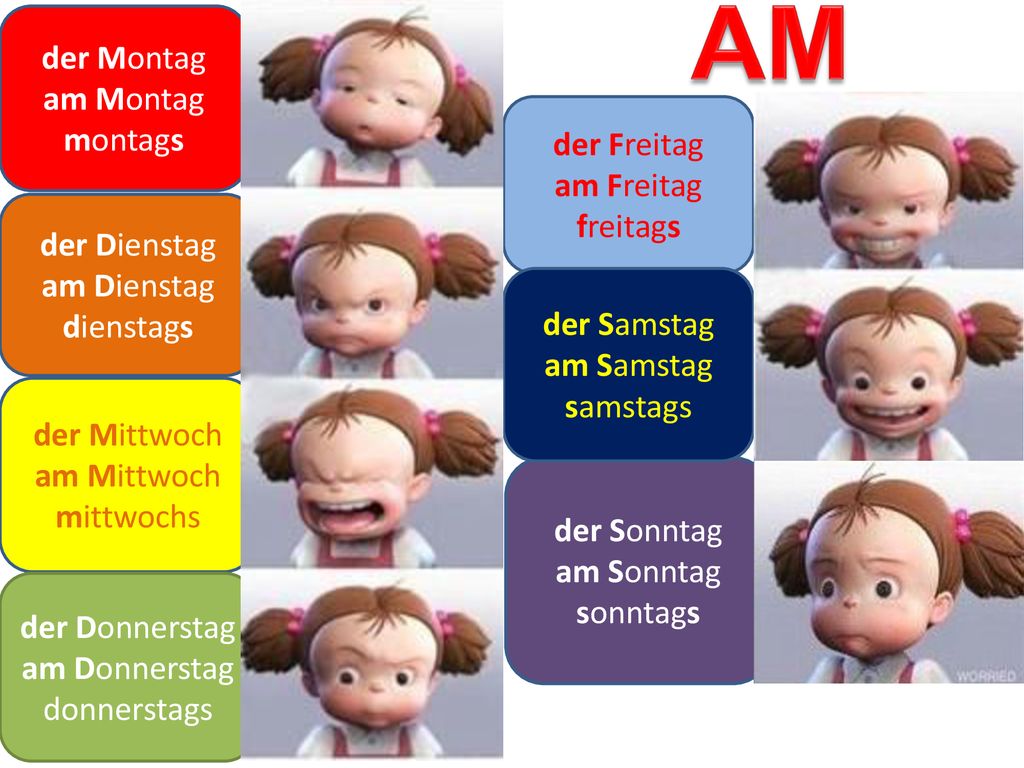
Let's tackle the phrase "am Freitag." It means "on Friday." You might wonder: why is there an "m" at the end of "a"?
This is because of a contraction. A contraction is when two words are joined together to make one shorter word. For example, "cannot" becomes "can't" in English.
In this case, "am" is a contraction of "an dem." "An" is a preposition. Prepositions show the relationship between a noun or pronoun and another word in the sentence. Think of words like "on," "in," "at," "to," "from," etc.
Deconstructing "An Dem"
So, we have "an dem Freitag." But wait! We know that "Freitag" means "Friday." Now we need to figure out the article for "Freitag."
The German word for Friday, Freitag, is masculine. This means it uses the article der. So, it should be "der Freitag."
Now we can reassemble the phrase. It should be "an der Freitag". But there is a rule! Certain prepositions, like "an," change the article of the noun that follows them. This is called declension.
Dative Case and "Dem"
"An" is one of those prepositions. Specifically, "an" is a two-way preposition. This means it can take either the accusative or dative case. In the context of time (like "on Friday"), it takes the dative case.
When "an" takes the dative case and the noun is masculine, "der" changes to "dem."
That's why it becomes "an dem Freitag." Finally, "an dem" contracts to "am." So, the complete phrase is "am Freitag."
Putting it All Together
Here's the breakdown once more:
Freitag (Friday) is masculine: der Freitag.
The preposition "an" requires the dative case in this context.
In the dative case, der changes to dem: an dem Freitag.
The contraction of "an dem" is "am": am Freitag.
Therefore, "am Freitag" means "on Friday." It's a grammatical journey, but understanding the steps makes it much easier.
Practice Makes Perfect
The best way to learn the articles is through practice. Pay attention to the articles used with different nouns. Try to memorize them along with the word itself.
Read German texts, listen to German speakers, and use flashcards. The more you expose yourself to the language, the more naturally you'll start to internalize the articles.
Good luck with your German studies! Don't be discouraged by the articles. With practice, you'll master them in no time. Remember, even native speakers make mistakes sometimes!