Day Of Month In Japanese

The Japanese way to say the day of the month is a little different from just saying numbers. You add a special ending to the numbers.
The Basics: Days 1-10
Let's start with the first ten days. These are special and use different words than just the regular numbers.
Here they are:
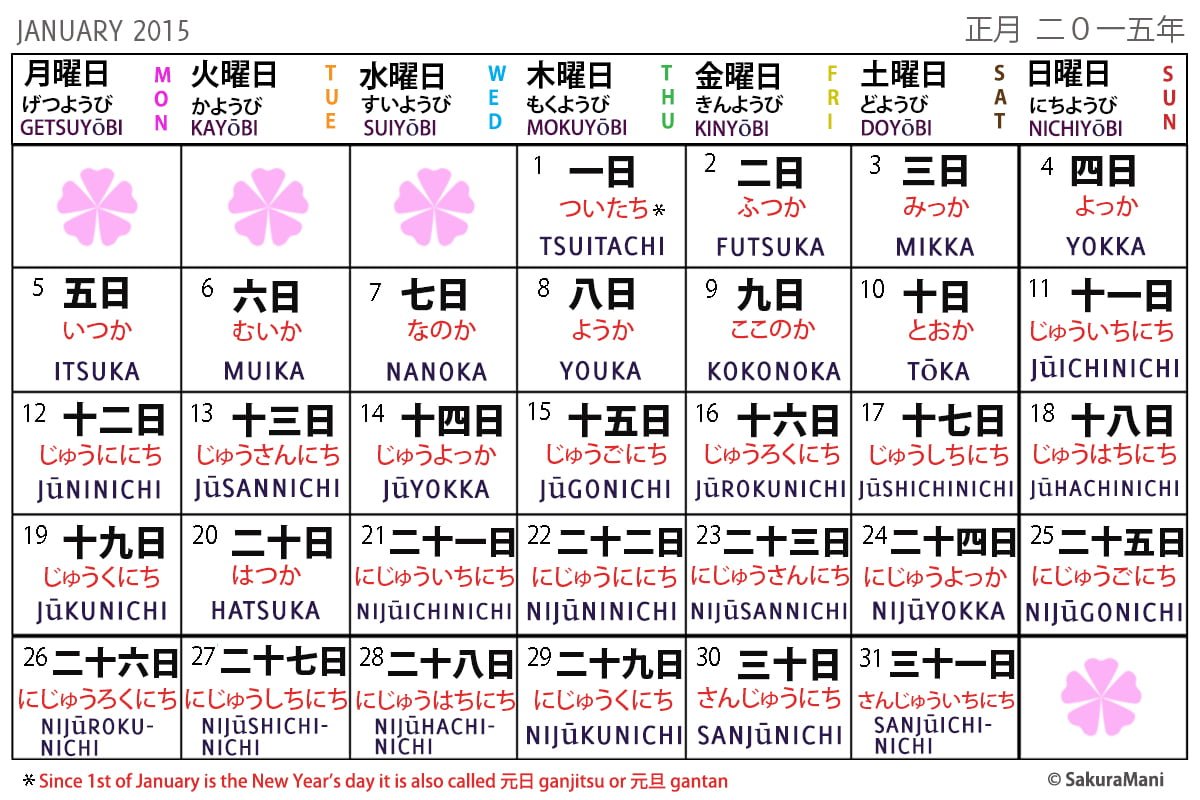
- 1st: Tsuitachi (ついたち or 一日)
- 2nd: Futsuka (ふつか or 二日)
- 3rd: Mikka (みっか or 三日)
- 4th: Yokka (よっか or 四日)
- 5th: Itsuka (いつか or 五日)
- 6th: Muika (むいか or 六日)
- 7th: Nanoka (なのか or 七日)
- 8th: Yooka (ようか or 八日)
- 9th: Kokonoka (ここのか or 九日)
- 10th: Tooka (とおか or 十日)
Notice these don't sound like regular Japanese numbers! These are old, traditional Japanese words.
Example: "Today is the 3rd." - "Kyou wa mikka desu." (今日はみっかです。)
Days 11-31: Numbers + -nichi
For the days from the 11th onwards, it gets simpler. You use the regular Japanese number and add -nichi (日) to the end.
Here are some examples:
- 11th: Juuichinichi (じゅういちにち or 十一日)
- 12th: Juuninichi (じゅうににち or 十二日)
- 13th: Juusannichi (じゅうさんにち or 十三日)
- 14th: We will cover this special exception later.
- 15th: Juugonichi (じゅうごにち or 十五日)
- 20th: We will cover this special exception later.
- 24th: We will cover this special exception later.
- 29th: Nijuukyuunichi (にじゅうくにち or 二十九日)
- 30th: Sanjuunichi (さんじゅうにち or 三十日)
- 31st: Sanjuuichinichi (さんじゅういちにち or 三十一日)
Example: "My birthday is the 15th." - "Watashi no tanjoubi wa juugonichi desu." (私の誕生日はじゅうごにちです。)
Important Exceptions
There are a few exceptions you need to remember. These are irregularities in the pronunciation:
- 14th: Instead of "Juuyonnichi", it's Juuyokka (じゅうよっか or 十四日).
- 20th: Instead of "Nijuunichi", it's Hatsuka (はつか or 二十日).
- 24th: Instead of "Nijuuyonnichi", it's Nijuuyokka (にじゅうよっか or 二十四日).
These exceptions are important. You will hear them often, so practice them!
Example: "The meeting is on the 14th." - "Kaigi wa juuyokka desu." (会議はじゅうよっかです。)
Putting It All Together
To say the full date, you usually say the year, month, and then the day. Remember to use the correct counters for each!
For example:
"March 3rd, 2024" would be:
"Nisen ni juu yon nen, san gatsu, mikka" (二千二十四年、三月、みっか)
Remember that year (nen 年) and month (gatsu 月) come *before* the day.
Practice Makes Perfect
The best way to learn the days of the month is to practice. Try saying your birthday, important holidays, or the current date in Japanese. Use flashcards or online quizzes to help you memorize the special readings for the first ten days and the exceptions like the 14th, 20th and 24th. Good luck!