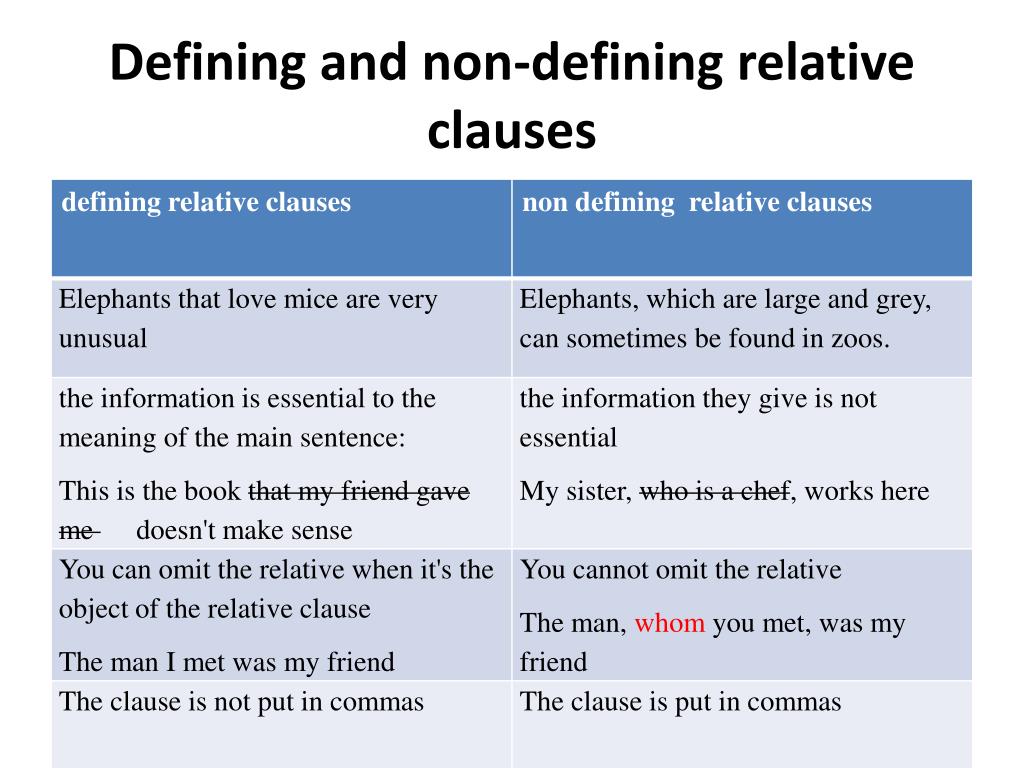
Defining And Non Defining Relative Clauses

Relative clauses are essential for adding detail to sentences. Let's explore defining and non-defining relative clauses, understanding their differences and how to use them effectively.
A defining relative clause, also known as a restrictive relative clause, provides information that is essential to identify the noun it modifies. Without it, the meaning of the sentence would be unclear. Think of it as narrowing down which specific person or thing you are talking about.
A non-defining relative clause, also known as a non-restrictive relative clause, gives extra information about the noun it modifies. This information is not essential; the sentence would still make sense without it. It's like adding a side note or an interesting fact.
Here's the key difference: a defining relative clause is vital for understanding the sentence's core meaning, while a non-defining relative clause simply adds extra detail.
Commas are crucial! This is the most straightforward way to distinguish between the two types of clauses. Non-defining relative clauses are always set off with commas. Defining relative clauses never are.
For example, consider these two sentences:
The book that I borrowed from the library is due next week. (Defining)
The book, which is a first edition, is very valuable. (Non-defining)
In the first sentence, "that I borrowed from the library" is a defining relative clause. It tells us which specific book we are talking about. Without it, we wouldn't know which book is due. No commas are needed.
In the second sentence, "which is a first edition" is a non-defining relative clause. It gives us extra information about the book, but we already know which book is being discussed. We could remove it, and the sentence would still make sense: "The book is very valuable." Commas are essential.
Here are some more examples to illustrate the difference:
Defining Relative Clauses (no commas):
- The student who studies hard usually gets good grades.
- The car that I want to buy is very expensive.
- The restaurant where we ate last night was excellent.
Non-Defining Relative Clauses (with commas):
- My sister, who lives in London, is a doctor.
- The Eiffel Tower, which is a famous landmark, attracts millions of tourists.
- My dog, which is a golden retriever, loves to play fetch.
Relative Pronouns and Adverbs: Both types of clauses use relative pronouns like who, whom, which, that and relative adverbs like where, when, why to connect to the main clause.
Consider the relative pronoun "that": It can often be used in defining relative clauses, but generally *which* should be used for non-defining relative clauses.
Practical Applications: Understanding defining and non-defining relative clauses improves your writing in several ways. You'll be able to provide precise and clear information to your reader. This helps your reader to easily follow what is being written and the message you wish to convey.
Consider using this knowledge when writing essays, reports, or even everyday emails. Using the correct punctuation, especially using commas for non-defining clauses, will help create clearer and more grammatically accurate sentences.
Furthermore, recognizing these clauses improves your reading comprehension. You'll better understand the relationships between different parts of a sentence and grasp the intended meaning more effectively. Paying attention to commas helps distinguish between vital information and added details.