Der Apfel Fällt Nicht Weit Vom Stamm Englisch
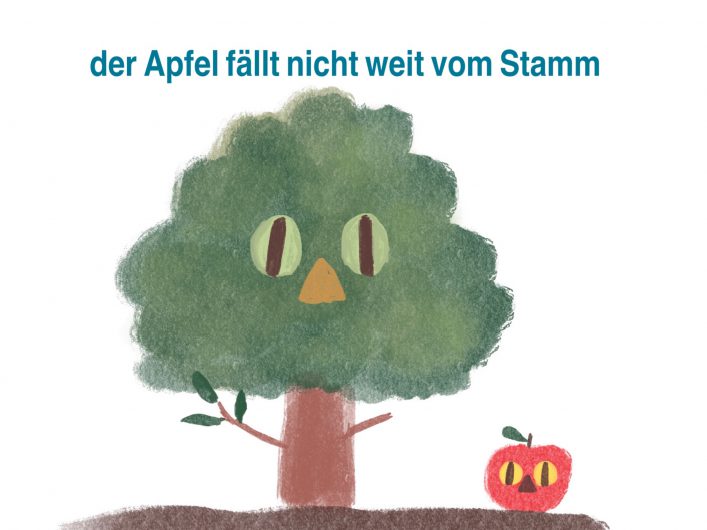
Der Apfel fällt nicht weit vom Stamm is a German proverb. It translates to "The apple doesn't fall far from the tree." It signifies that children often resemble their parents in character, behavior, or abilities.
The core meaning centers around heredity and environment. A child's traits are influenced by both their genetic inheritance and the environment in which they are raised. Therefore, a child’s personality is often a reflection of their upbringing.
One key aspect is the notion of inherited traits. This includes physical characteristics, such as height or eye color. It can also encompass predispositions to certain skills or talents. For example, a parent who is musically inclined might have a child who also shows a natural aptitude for music. The adage suggests this is not mere coincidence, but an expected outcome.
Another crucial aspect is the influence of the environment. Parents set an example for their children. Children learn by observing their parents' actions and attitudes. If a parent is hardworking and dedicated, the child is more likely to develop similar qualities. The family provides a key setting where early personality development happens.
The proverb doesn't necessarily imply a positive resemblance. It can also apply to negative traits. If a parent is prone to anger, their child might also struggle with anger management. This highlights the double-edged sword nature of the saying. Children can mirror undesirable traits as well.
The phrase also acknowledges the potential for deviation. While children often resemble their parents, they are still individuals. They possess their own unique experiences and personalities. The apple may not fall *far*, but it doesn't fall *directly* at the base of the tree either. Individual development will always introduce certain differences.
Example 1: A family of doctors where the child also becomes a successful doctor. People might say, "Der Apfel fällt nicht weit vom Stamm." This explains the likelihood of the child becoming a doctor since the parents are in the medical field.
Example 2: A parent who is constantly late. The child also frequently misses appointments and is always running behind. One might comment that "Der Apfel fällt nicht weit vom Stamm." This demonstrates the transmission of a negative habit.
The saying can be seen in different cultures. Similar proverbs exist across various languages. This underlines the universality of the concept that children are often reflections of their parents.
In the real world, "Der Apfel fällt nicht weit vom Stamm" can be used to understand family dynamics. It can help us to see the connections between generations. It can provide insights into how upbringing and heredity shape individuals. But importantly, it should never be used as an excuse to limit a child's potential. The proverb offers an observation, not a predestination.