Der Die Das Dativ Akkusativ

Hallo! Learning German grammar can feel daunting, but understanding der, die, das, Dativ, and Akkusativ is crucial. This guide breaks down these concepts in a simple, approachable way.
The most important thing to remember is this: der, die, and das are the German words for "the." They are called definite articles. Dativ and Akkusativ are grammatical cases that change the form of these articles (and other words) depending on their function in a sentence.
Think of grammatical cases like roles in a play. The article (der, die, das) changes its costume (its form) depending on the role it's playing in the sentence.
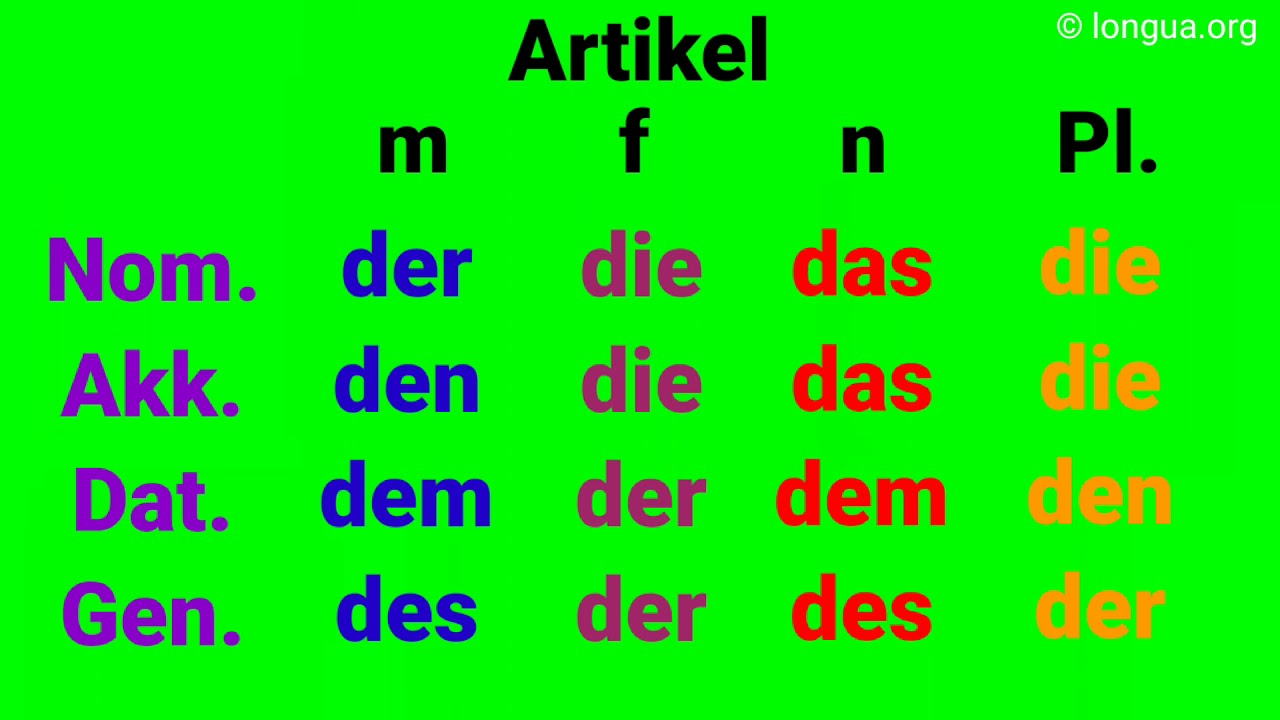
Let's start with the Nominativ case. This is the "default" case, and it's used for the subject of the sentence. The subject is the one *doing* the action. These are the nominative articles:
- der - masculine
- die - feminine
- das - neuter
- die - plural
Example: Der Mann liest. (The man reads.) "Der Mann" is the subject, so "der" stays "der."
Now, let's look at the Akkusativ case. The Akkusativ is primarily used for the direct object of the sentence. This is the person or thing that *receives* the action. Only the masculine article changes in the Akkusativ.
- den - masculine (changes from "der")
- die - feminine (stays the same)
- das - neuter (stays the same)
- die - plural (stays the same)
Example: Ich sehe den Mann. (I see the man.) "Den Mann" is the direct object, receiving the action of "seeing," so "der" changes to "den." Notice that "Ich esse die Pizza," and "Ich esse das Brot." use "die" and "das", as the feminine and neuter article does not change.
Finally, we have the Dativ case. The Dativ is often used for the indirect object. This is often (but not always!) the person or thing *receiving* something. All the articles change in the Dativ case. This is the most complicated case for new learners.
- dem - masculine
- der - feminine
- dem - neuter
- den - plural
Example: Ich gebe dem Mann das Buch. (I give the man the book.) "Dem Mann" is the indirect object, receiving the book. "Das Buch" is the direct object. See how "der" changes to "dem." Similarly, "Ich helfe der Frau" (I help the woman). "Die" becomes "der."
A helpful hint: prepositions like mit, nach, aus, zu, von, bei, and seit almost always require the Dativ case.
Here are some practical ways to apply this knowledge:
- Start simple: Focus on recognizing the articles in simple sentences.
- Practice with flashcards: Create flashcards with nouns and their corresponding articles in each case.
- Read German texts: Pay attention to how the articles change in different contexts.
- Use online resources: There are many websites and apps that offer exercises and explanations on German grammar.
Understanding der, die, das, Dativ, and Akkusativ is a journey, not a destination. Be patient with yourself, practice consistently, and don't be afraid to make mistakes. Every mistake is a learning opportunity! Viel Erfolg!