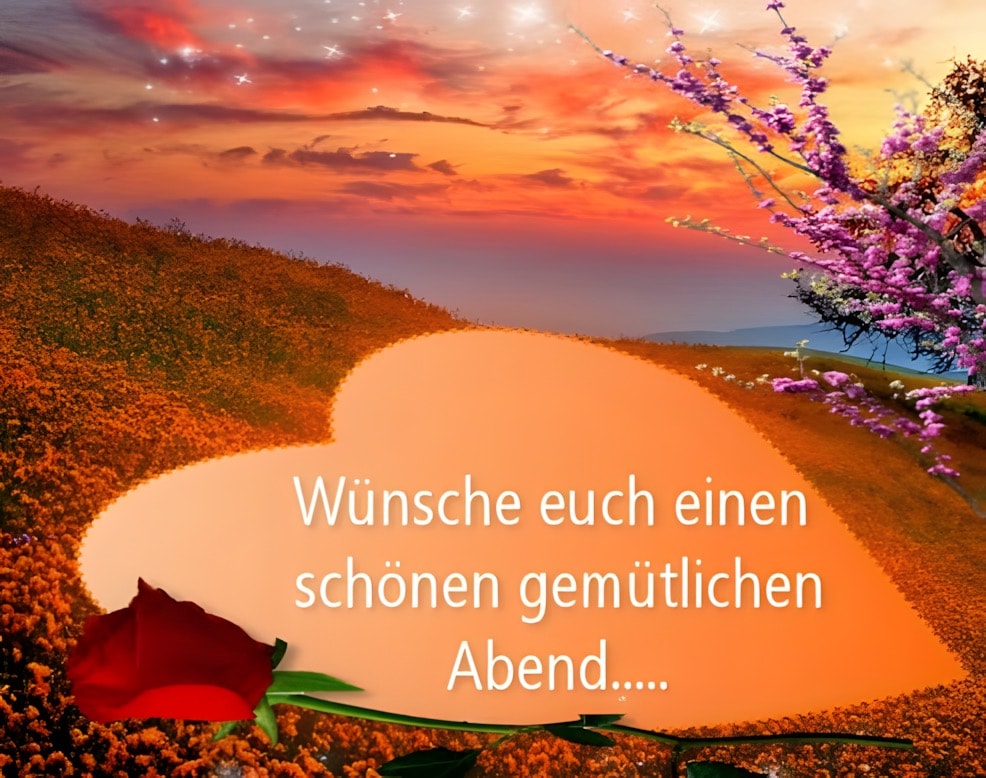
Einen Schönen Abend Wünsche Ich Dir

"Einen schönen Abend wünsche ich dir" means "I wish you a pleasant evening" in German. It's a friendly and polite way to say goodbye or end a conversation as evening approaches.
Breaking it Down: Word by Word
Let's dissect this phrase to understand it fully:
- Einen: (pronounced "eye-nen") This is the accusative masculine singular form of the indefinite article "ein," meaning "a" or "one." In this case, it modifies "Abend."
- schönen: (pronounced "sho-nen") This is the accusative masculine singular form of the adjective "schön," meaning "beautiful," "pleasant," or "nice." It describes the evening.
- Abend: (pronounced "ah-bent") This is a noun meaning "evening." It is masculine.
- wünsche: (pronounced "vun-she") This is the first-person singular form of the verb "wünschen," meaning "to wish." "Ich wünsche" means "I wish."
- ich: (pronounced "ich") This is the pronoun "I." It's often included for emphasis, but it could be omitted.
- dir: (pronounced "deer") This is the dative singular form of the pronoun "du," meaning "you" (informal).
Putting it Together: Meaning and Context
When you combine all these words, you get a sentence that expresses a warm wish for a nice evening. The sentence structure emphasizes that you are the one doing the wishing, and the "dir" shows that you are wishing it specifically to the person you're talking to. The word order, while following German grammar rules, creates a polite and thoughtful sentiment.
When to Use It: Practical Examples
Here are some situations where you might use "Einen schönen Abend wünsche ich dir":
- After a meeting with a colleague: "Okay, dann bis morgen. Einen schönen Abend wünsche ich dir!" (Okay, see you tomorrow. I wish you a pleasant evening!)
- Ending a phone call with a friend: "Ja, mach's gut. Einen schönen Abend wünsche ich dir!" (Yes, take care. I wish you a pleasant evening!)
- Saying goodbye to a neighbor: "Auf Wiedersehen! Einen schönen Abend wünsche ich dir!" (Goodbye! I wish you a pleasant evening!)
- After helping someone with a task: "Gerne geschehen! Einen schönen Abend wünsche ich dir!" (You're welcome! I wish you a pleasant evening!)
Formal vs. Informal: Knowing Your Audience
"Einen schönen Abend wünsche ich dir" is an informal expression because it uses "dir," the dative form of "du" (the informal "you"). To be more formal, you would use "Ihnen" (the dative form of "Sie," the formal "you"). The formal version would be: "Einen schönen Abend wünsche ich Ihnen." Use the formal version when speaking to someone you don't know well, someone older than you, or someone in a position of authority.
Variations and Similar Phrases
While "Einen schönen Abend wünsche ich dir" is perfectly acceptable, here are a few slight variations:
- Schönen Abend noch! (Nice evening still!) This is a shorter, more casual way to say "Have a nice evening."
- Ich wünsche dir einen schönen Abend. (I wish you a pleasant evening.) This has the same meaning but a slightly different word order.
- Hab' einen schönen Abend! (Have a nice evening!) – Very informal and shortened.
Pronunciation Tips
Pay attention to the pronunciation, especially the "sch" sound (like "sh" in English) and the "ü" sound (which doesn't exist in English and requires rounding your lips). Practice saying it slowly at first, then gradually increase your speed.
In Conclusion
"Einen schönen Abend wünsche ich dir" is a valuable phrase to add to your German vocabulary. It shows politeness, friendliness, and good manners. Now you understand its meaning, structure, and usage. Übung macht den Meister! (Practice makes perfect!)