Emily Dickinson Hope Is A Thing With Feathers Analysis

Hope: A Bird Inside? Let's Explore Dickinson's Poem
Ever heard the saying "keep your chin up?" That's basically what Emily Dickinson's poem, "Hope is the thing with feathers," is all about. We're going to unpack this poem, line by line, and see how Dickinson uses a bird to represent hope. Think of it like decoding a secret message!
First, let's get some definitions straight. Metaphor is when you compare two unlike things without using "like" or "as." For example, saying "He is a lion" means he is brave, even though he's not literally a lion. Got it? Personification is giving human qualities to non-human things. Think of your car "complaining" when it needs gas. Poems use this to make writing more vivid.
The Poem's First Stanza: Hope Takes Flight
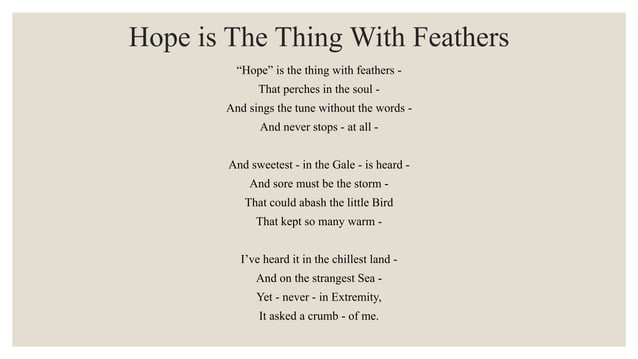
The poem starts with: "Hope is the thing with feathers – / That perches in the soul –." Right away, Dickinson introduces her central metaphor. Hope isn't literally a bird, but she uses the image of a bird to describe what hope feels like. The bird "perches" in our soul. Think of "perching" like a bird landing comfortably on a branch. It's settled, present, and ready to sing.
She continues: "And sings the tune without the words – / And never stops – at all –." Notice how hope sings a song "without the words." This means that hope is more of a feeling than something you can explain logically. It's a constant presence, like a song that "never stops." Even when things get tough, hope keeps singing in the background.
The Second Stanza: Hope in the Storm
Now, Dickinson moves on to tougher times: "And sweetest – in the Gale – is heard – / And sore must be the storm –." The "Gale" here represents a difficult situation or hardship. Gale, in old English, stands for powerful winds. Even in the midst of a powerful storm, hope's song is the "sweetest." This means that when things are at their worst, hope is the most valuable.
She continues: "that could abash the little Bird / That kept so many warm –." "Abash" means to embarrass or discourage. Dickinson suggests that the storm must be incredibly powerful to silence hope ("the little Bird"). However, even in the face of a huge challenge, hope has kept "so many warm." This shows the power of hope to sustain us and others through difficult times.
The Third Stanza: Hope's Generosity
The final stanza focuses on the selfless nature of hope: "I’ve heard it in the chillest land – / And on the strangest Sea –." Dickinson has experienced hope in the "chillest land" and on the "strangest Sea." These phrases represent the most desolate and unfamiliar places, both physically and emotionally. She’s saying she's found hope everywhere.
She finishes with: "Yet – never – in Extremity, / It asked a crumb – of Me." "Extremity" means extreme hardship or need. Here, Dickinson emphasizes that even when she was at her lowest point, hope never asked for anything in return. It's a freely given gift, a constant source of strength that requires no payment or recognition. Hope gives everything it has, without asking anything for itself.
Putting It All Together: What Does It Mean?
So, what's the big picture? Dickinson uses the extended metaphor of a bird to show that hope is a constant, resilient force within us. It sings even in the toughest storms, and it asks for nothing in return. It's a powerful message about the importance of holding onto hope, even when things seem bleak. Think about the last time you felt discouraged. What helped you keep going? That was probably your "bird" of hope singing its song!
By understanding the metaphors and personification in Dickinson's poem, we can gain a deeper appreciation for the power of hope in our own lives. It's a small poem with a big message: never underestimate the strength of that little bird singing in your soul.