Good Afternoon In German Language

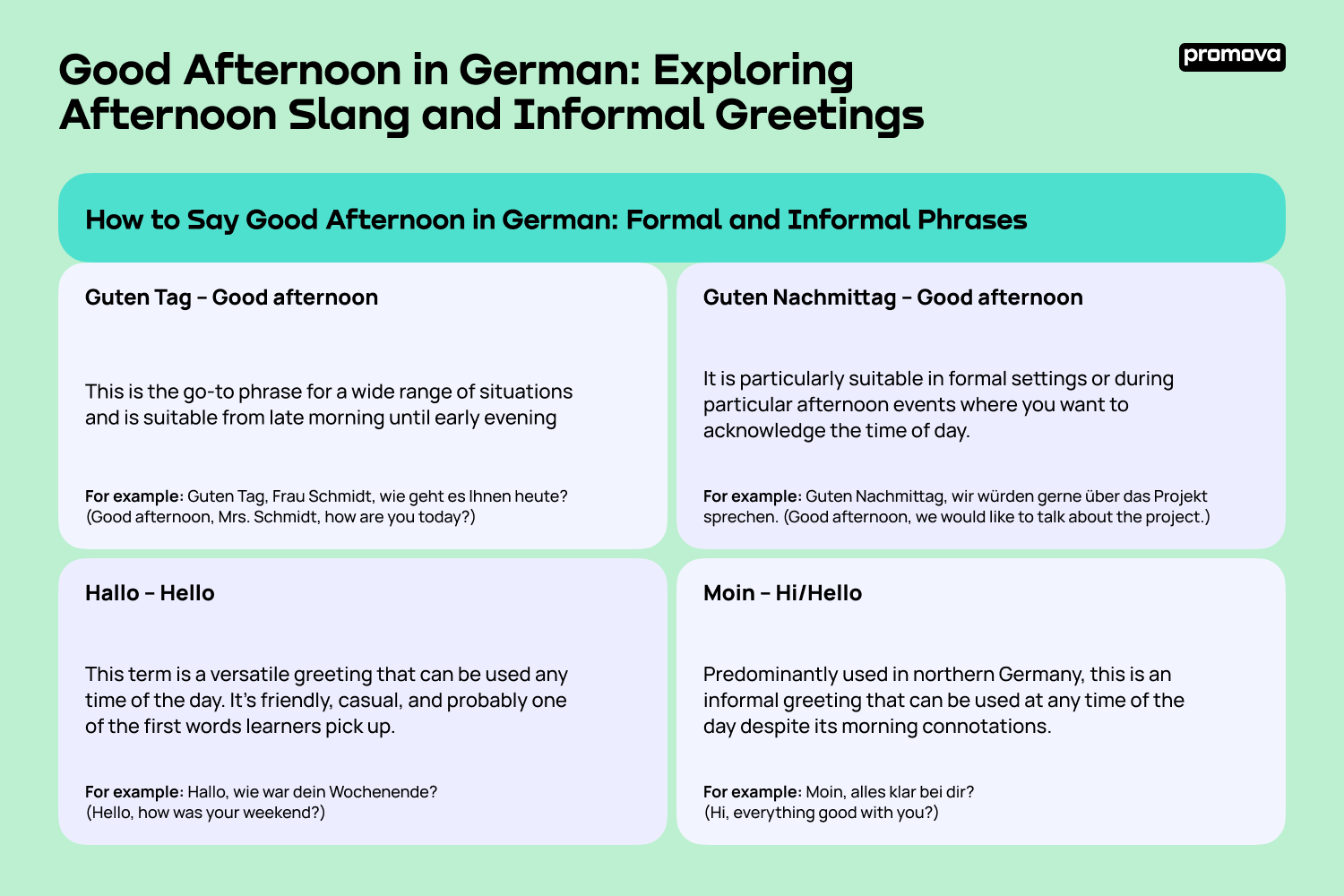
Guten Tag! Directly translated, this means "Good Day." It's the most common way to say Good Afternoon in German.
Let's break down how and when to use it. Guten Tag is a versatile greeting suitable for formal and informal situations. It's generally used from late morning until the evening. Think of it as the German equivalent of "Good Day" or "Hello," usable in most contexts during daylight hours.
Here’s a step-by-step breakdown:
- Timing: The most important factor. Use Guten Tag between roughly 10 AM and 6 PM. Before 10 AM, use Guten Morgen (Good Morning). After 6 PM, switch to Guten Abend (Good Evening).
- Pronunciation: Goo-ten Tahg. Focus on the "oo" sound in "Guten" and a clear "ah" sound in "Tag." Audio resources online can be very helpful here.
- Formality: Guten Tag works in almost any setting. Greeting a shopkeeper? Guten Tag! Meeting your boss? Guten Tag! It's a safe and respectful choice.
- Response: If someone greets you with Guten Tag, the simplest and most appropriate response is to reply with Guten Tag as well. You can also add your name: Guten Tag, Herr/Frau [Nachname] (Good Day, Mr./Ms. [Last Name]).
Let's look at some examples:
Scenario: Entering a bakery in the afternoon.
You: Guten Tag!
Baker: Guten Tag! Was darf es sein? (What can I get for you?)
Scenario: Meeting a colleague in the hallway.
You: Guten Tag, Frau Schmidt.
Frau Schmidt: Guten Tag, Herr Müller.
While Guten Tag is widely used, remember regional variations exist. In some parts of Southern Germany and Austria, you might hear Grüß Gott, which is a more regional greeting. However, Guten Tag will always be understood and accepted.
It's important to note that you would not directly translate "Good Afternoon" into German as its own isolated phrase. The nuance is captured within Guten Tag. The German language often uses a broader stroke in its greetings, focusing on the overall time of day rather than a specific segment.
Why is knowing Guten Tag important?
- Basic Communication: It’s a fundamental greeting. Knowing it allows you to initiate conversations and show politeness.
- Cultural Sensitivity: Using appropriate greetings demonstrates respect for German culture and customs. It shows you've made an effort to learn and understand.
Learning and using Guten Tag is a crucial first step to mastering German greetings and showing respect in German-speaking environments. Practice using it in different contexts to become more comfortable and confident in your language skills.