Ich Habe Einen Termin Englisch
"Ich Habe Einen Termin": Navigating Appointments in German
Understanding how to talk about appointments in German is crucial for everyday communication. The phrase "Ich habe einen Termin" is the foundation. It translates directly to "I have an appointment." This simple phrase opens doors to scheduling and discussing plans.
Breaking down the phrase, "Ich" means "I." "Habe" is the conjugated form of the verb "haben", meaning "to have." Finally, "einen Termin" translates to "an appointment." Each word plays a vital role in conveying the intended meaning. Understanding the components makes learning easier.
Teaching Strategies for the Classroom
Start with the basics. Introduce the phrase "Ich habe einen Termin" with visual aids. Pictures depicting different types of appointments (doctor, dentist, hairdresser) can be helpful. Pair the image with the phrase repeatedly.
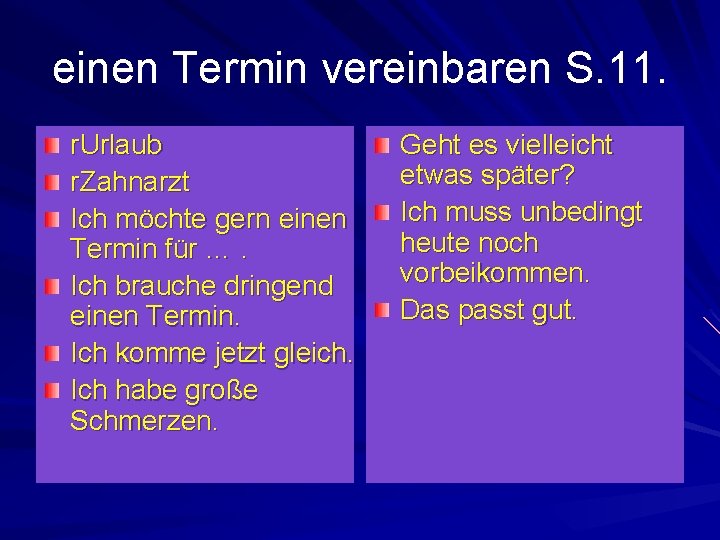
Use role-playing activities. Have students practice making and confirming appointments with each other. Provide sentence starters like "Ich möchte einen Termin..." (I would like an appointment...) or "Passt Ihnen...?" (Does ... work for you?). This practical application reinforces understanding.
Incorporate authentic materials. Use examples of German appointment confirmations or dialogues. This exposes students to how the language is used in real-world situations. It bridges the gap between classroom learning and practical application.
Common Misconceptions
One common misconception is thinking "Termin" only refers to doctor's appointments. While it certainly applies to medical settings, "Termin" is a general term. It can refer to any scheduled meeting or appointment, like with a lawyer or a friend.
Students might also struggle with the accusative case. "Einen Termin" uses the accusative form because it's the direct object of the verb "haben." Briefly review accusative articles (ein, einen, eine, ein) to address this grammatical nuance. Focus on consistent practice to solidify the concept.
Another issue arises with related vocabulary. Students may not know words for specific types of appointments. Introduce vocabulary related to various appointments, such as "der Arzttermin" (doctor's appointment) or "das Vorstellungsgespräch" (job interview). Expand their vocabulary incrementally.
Making it Engaging
Turn appointment scheduling into a game. Create scenarios where students need to book appointments for different services. They earn points for correctly using the phrases and relevant vocabulary. Gamification adds an element of fun and competition.
Use technology to enhance learning. Interactive online exercises and quizzes can reinforce the concepts. There are numerous free resources available that provide targeted practice. Leverage technology to cater to different learning styles.
Incorporate cultural insights. Discuss the importance of punctuality in German culture. Explain the typical way Germans schedule and confirm appointments. Cultural context enriches the learning experience.
Expanding on the Basics
Once students are comfortable with "Ich habe einen Termin," introduce related phrases. "Ich brauche einen Termin" (I need an appointment) is another useful expression. "Kann ich einen Termin vereinbaren?" (Can I make an appointment?) expands their repertoire.
Teach students how to specify the type of appointment. They can say "Ich habe einen Termin beim Arzt" (I have a doctor's appointment). Or "Ich habe einen Termin beim Zahnarzt" (I have a dentist appointment). This adds precision to their communication.
Introduce phrases for canceling or rescheduling. "Ich möchte meinen Termin absagen" (I would like to cancel my appointment) is important. "Ich möchte meinen Termin verschieben" (I would like to reschedule my appointment) is also crucial. Equip them with the language to handle unexpected situations.
Encourage students to use the new vocabulary in different contexts. Have them write short dialogues or create presentations. The more they practice, the more confident they will become. Consistent application is key to mastery.
Remember to provide constructive feedback and encouragement. Learning a new language can be challenging, so praise their efforts. Create a supportive and positive learning environment. This fosters confidence and motivation.