Ich War Du Warst Ihr Wart

Let's face it, German grammar can feel like scaling a mountain. And verb conjugation, especially past tense, often brings a collective groan. But understanding the simple past tense – specifically forms like "Ich war," "Du warst," and "Ihr wart" – is crucial for expressing past experiences and truly connecting with the language. This guide aims to demystify these forms and show you why they matter.
Think about telling a friend about your weekend. You wouldn't say "Ich bin gehen Kino" (I am go cinema). You'd need to say "Ich war im Kino" (I was at the cinema). The past tense allows you to narrate stories, describe events, and share memories – it's the backbone of any good conversation about yesterday!
Understanding "Sein" - The Verb "To Be"
"Ich war," "Du warst," and "Ihr wart" are all conjugations of the verb "sein", which means "to be" in English. This verb is fundamental. Just like in English, "to be" is used to describe states of being, locations, and identities.
Why is "Sein" Important?
Consider these examples:
- Ich war müde. (I was tired.) - Describing a state of being.
- Du warst in Berlin. (You were in Berlin.) - Describing a location.
- Ihr wart meine besten Freunde. (You were my best friends.) - Describing an identity/relationship.
Without knowing the past tense of "sein", you're limited to talking about the present. You can’t share your past joys, sorrows, or adventures. Think of "sein" as the foundation upon which you build more complex sentences in the past tense.
Conjugating "Sein" in the Simple Past (Präteritum)
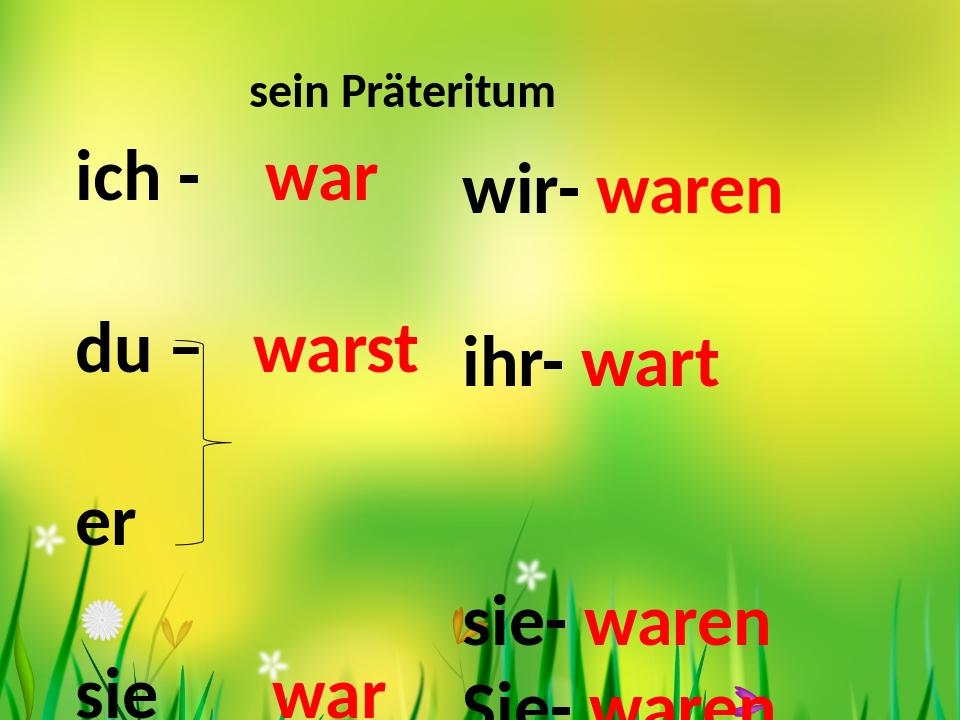
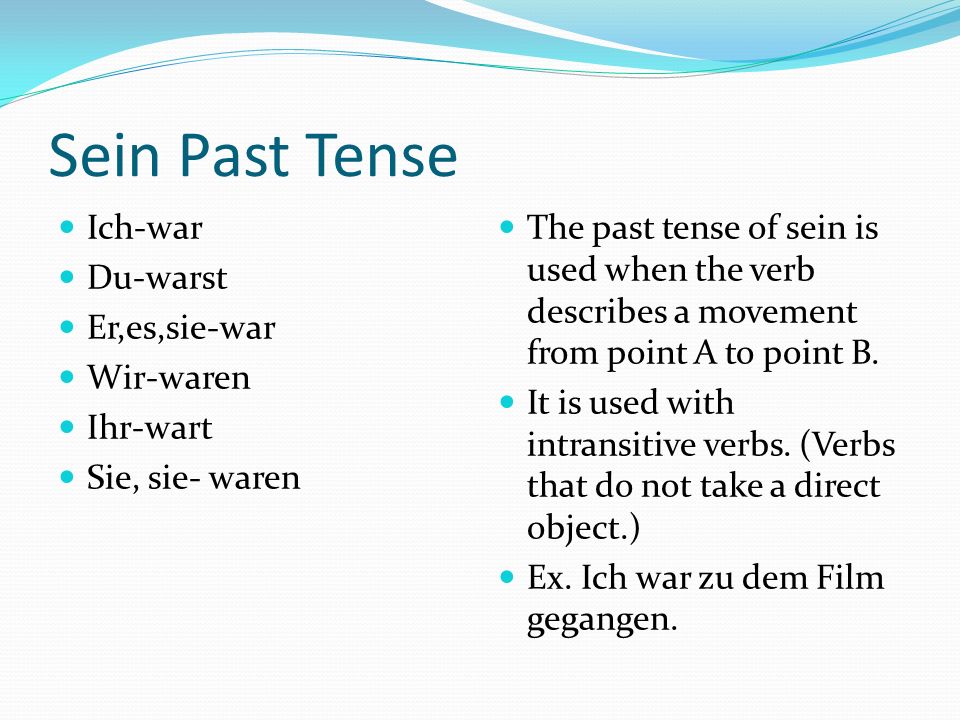
The forms "Ich war," "Du warst," and "Ihr wart" belong to the simple past tense, also known as the *Präteritum* in German. While German has another past tense, the *Perfekt*, the *Präteritum* is still very common, especially in written German and formal spoken language. Here's the full conjugation of "sein" in the simple past:
- Ich war (I was)
- Du warst (You were - singular, informal)
- Er/Sie/Es war (He/She/It was)
- Wir waren (We were)
- Ihr wart (You were - plural, informal)
- Sie waren (They were / You were - formal)
Notice the patterns. While memorizing the forms is important, recognizing these patterns can help you learn other verb conjugations as well.
Focus on "Ich war", "Du warst", and "Ihr wart"
For this guide, we'll focus on these three forms. Mastering these will give you a solid foundation for understanding the whole concept.
- Ich war: This is the first-person singular – "I was". Example: "Ich war sehr glücklich, dich zu sehen." (I was very happy to see you.)
- Du warst: This is the second-person singular, informal – "You were". Use this when speaking to someone you're on familiar terms with. Example: "Du warst so nett zu mir." (You were so nice to me.)
- Ihr wart: This is the second-person plural, informal – "You (all) were". Use this when speaking to a group of people you're on familiar terms with. Example: "Ihr wart alle sehr hilfsbereit." (You were all very helpful.)
Common Mistakes and How to Avoid Them
One common mistake is confusing the *Präteritum* with the *Perfekt*. While both are past tenses, they are used differently. Generally, the *Präteritum* is more common in written German and formal spoken contexts, while the *Perfekt* is more common in everyday conversation. However, some verbs, like "sein", are frequently used in the *Präteritum* even in spoken German.
Another mistake is incorrectly conjugating the verb. Double-check your endings and remember that "sein" is an irregular verb, meaning it doesn't follow the regular conjugation rules.
A helpful tip: Practice, practice, practice! The more you use these forms in sentences, the more natural they will become. Use online resources, language exchange partners, or even just write out sentences to reinforce your learning.
Real-World Examples and Usage
Let's look at some practical examples to see how "Ich war," "Du warst," and "Ihr wart" are used in everyday situations:
- Scenario: Talking about a past trip.
- "Ich war letztes Jahr in Italien." (I was in Italy last year.)
- "Du warst auch dort, oder?" (You were there too, right?)
- "Ihr wart alle zusammen unterwegs." (You were all traveling together.)
- Scenario: Describing a feeling or state of being.
- "Ich war sehr nervös vor dem Examen." (I was very nervous before the exam.)
- "Du warst so mutig, als du das gesagt hast." (You were so brave when you said that.)
- "Ihr wart so begeistert von dem Konzert." (You were so enthusiastic about the concert.)
- Scenario: Discussing past events or relationships.
- "Ich war dein Nachbar vor fünf Jahren." (I was your neighbor five years ago.)
- "Du warst mein bester Freund in der Grundschule." (You were my best friend in elementary school.)
- "Ihr wart die Ersten, die mir geholfen haben." (You were the first ones to help me.)
These examples show how "Ich war," "Du warst," and "Ihr wart" are essential for expressing past experiences, feelings, and relationships. They allow you to create richer and more nuanced conversations.
Addressing Counterpoints: Why Not Just Use "Perfekt"?
You might be thinking, "Why bother learning the *Präteritum* when I can just use the *Perfekt*?" That's a valid question! The *Perfekt* is indeed more common in everyday spoken German. However, the *Präteritum* is still important for several reasons:
- Formal writing: The *Präteritum* is the preferred tense in formal writing, such as news articles, academic papers, and novels.
- Certain verbs: Some verbs, like "sein" (to be), "haben" (to have), and modal verbs (e.g., "können," "müssen," "wollen"), are frequently used in the *Präteritum*, even in spoken German.
- Reading comprehension: To understand written German, you need to be familiar with the *Präteritum*.
- Expressing nuance: In some cases, the *Präteritum* can convey a slightly different nuance than the *Perfekt*.
While focusing on the *Perfekt* is a good starting point, mastering the *Präteritum* will elevate your German skills and allow you to engage with the language on a deeper level.
Tips for Mastering "Ich War", "Du Warst", and "Ihr Wart"
Here are some actionable tips to help you master these forms:
- Flashcards: Create flashcards with the verb form on one side and example sentences on the other.
- Sentence building: Practice building sentences using "Ich war", "Du warst", and "Ihr wart" in different contexts.
- Reading and listening: Pay attention to how these forms are used in German texts and audio materials.
- Language exchange: Practice using these forms in conversation with native speakers.
- Online exercises: Utilize online resources and apps that offer grammar exercises focused on the *Präteritum*.
- Journaling: Write about your day in German, using the past tense as much as possible.
Remember: Consistency is key. Even dedicating just a few minutes each day to practicing will make a significant difference over time.
Moving Beyond the Basics
Once you're comfortable with "Ich war," "Du warst," and "Ihr wart," you can start exploring the *Präteritum* of other verbs. Begin with regular verbs, as their conjugation patterns are more predictable. Then, tackle irregular verbs, paying close attention to their stem changes.
Also, consider exploring the nuances between the *Präteritum* and the *Perfekt* to gain a deeper understanding of when to use each tense. There are subtle differences that can affect the meaning of your sentences.
In Summary
Understanding the forms "Ich war," "Du warst," and "Ihr wart" is a crucial step in mastering German grammar. They allow you to express past experiences, feelings, and relationships, opening up a whole new world of communication. While the *Perfekt* is more common in everyday spoken German, the *Präteritum* remains important for formal writing and understanding written German. By practicing regularly and utilizing the tips outlined in this guide, you can confidently use these forms and improve your overall German proficiency.
So, after reading this guide, what past experience are you going to describe using "Ich war", "Du warst", or "Ihr wart"? Try writing a few sentences right now to solidify your understanding!