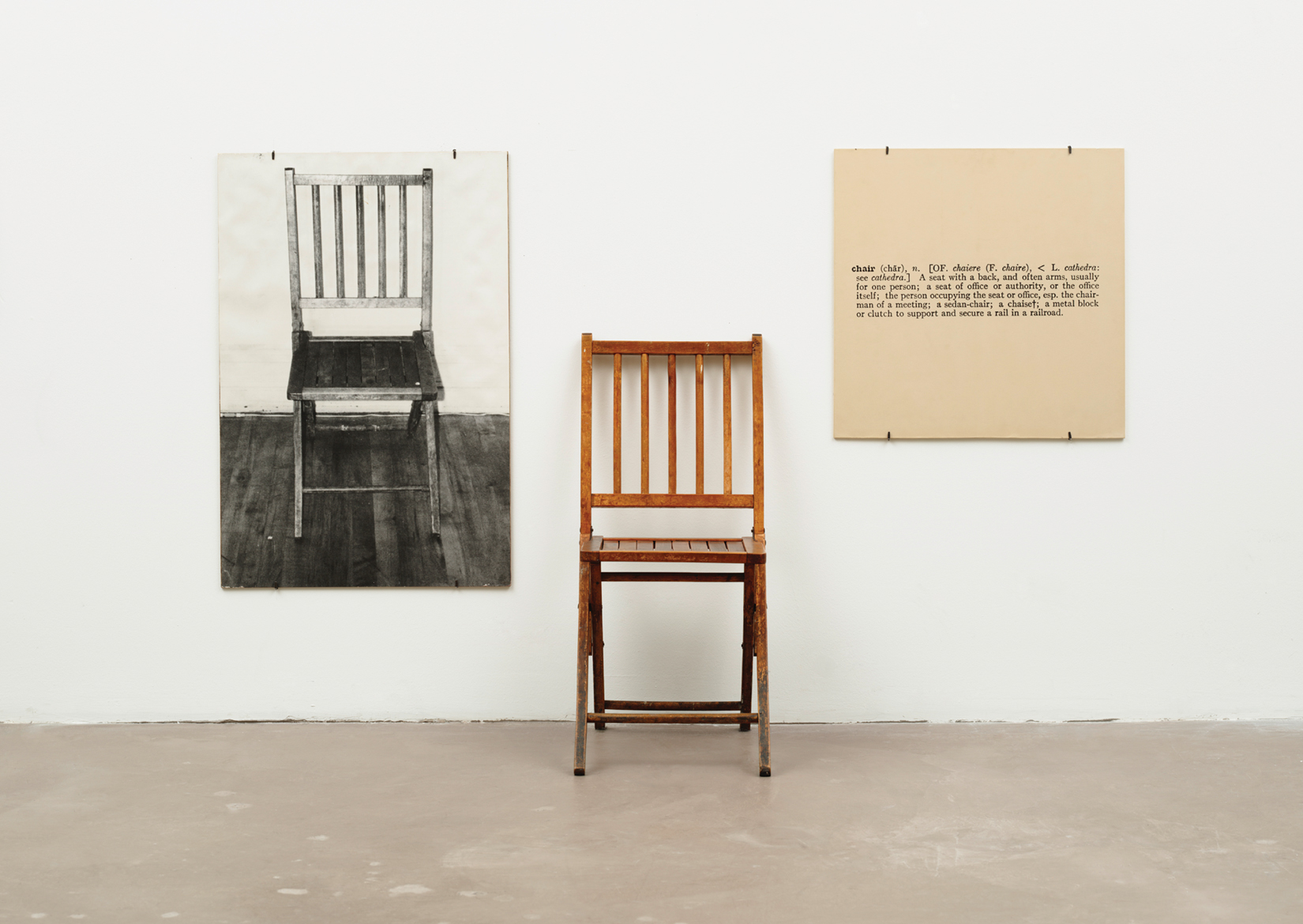
Joseph Kosuth One And Three Chairs

Joseph Kosuth's One and Three Chairs is a conceptual art piece. It shows one object in three different forms. This challenges what we think art is.
What are the Three Forms?
One and Three Chairs typically includes:
- A chair: An actual, physical chair. It's a real object you could sit on.
- A photograph of the chair: A picture taken of the same chair. It represents the chair.
- A definition of "chair": A dictionary definition, usually enlarged and displayed. This is a linguistic representation of the idea of a chair.
So, we have the object, its image, and its definition. All three are presented together as a single artwork.
The Idea Behind the Work
Kosuth wanted to make people think. He wasn't focused on making something beautiful to look at. He was interested in ideas. The artwork is about the concept of a chair, not just the object itself.
Think about it: Which one is the "real" chair? Is it the physical object? Or is it the definition that tells us what a chair is? Or is it the photograph that captures its appearance?
Kosuth argues that none of them is truly "the chair." They are all just different ways of representing the idea of a chair. The true artwork is the idea itself.
Why is it Conceptual Art?
Conceptual art puts the idea first. The physical artwork is just a way to express that idea. The idea is more important than the craft or skill used to create the object.
In the case of One and Three Chairs, the execution is simple. The photo doesn't need to be perfectly artistic. The chair itself doesn't need to be a masterpiece of design. What matters is the relationship between the chair, its image, and its definition.
This is very different from traditional art. Traditionally, artists focused on creating beautiful paintings or sculptures. The skill and technique were very important. Conceptual art turned this upside down.
An Everyday Example
Imagine you want to explain "dog" to someone. You could:
- Show them a real dog (the object).
- Show them a picture of a dog (the image).
- Tell them the dictionary definition of "dog" (the definition).
Each of these shows what a dog is, but in a different way. Kosuth uses this same idea with the chair.
Variations of the Work
One and Three Chairs isn't always exactly the same. Kosuth often used a different chair depending on where the work was being shown. He might use whatever chair was available in the gallery. This reinforces the idea that the specific chair is not the point. It's the idea of "chairness" that matters.
Similarly, the photograph would be taken of the chosen chair. The definition would remain constant, typically a standard dictionary definition.
The Lasting Impact
One and Three Chairs is a landmark piece of conceptual art. It challenged traditional ideas about art. It pushed artists to think about the importance of ideas. It continues to influence artists today.
By focusing on the concept, Kosuth asked us to question what we see. He forced us to think about the relationship between objects, images, and language. He showed that art can be about thinking, not just seeing.