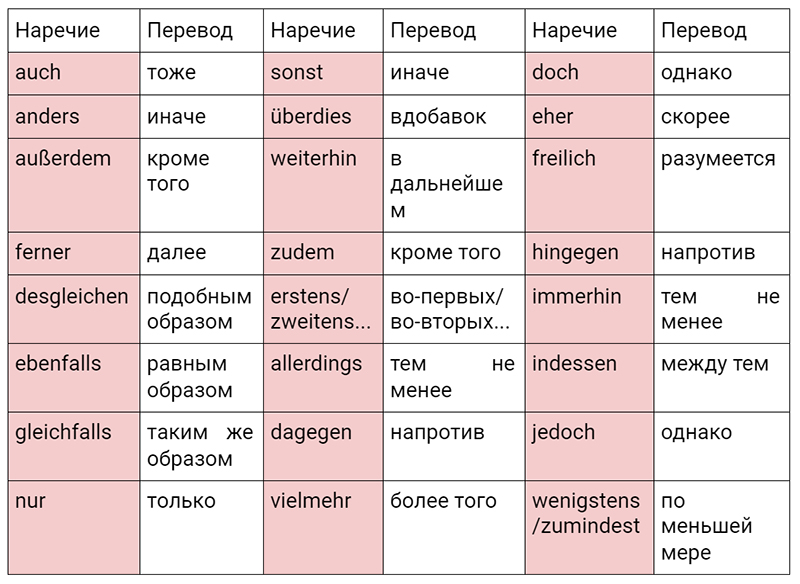
местоименные наречия в немецком языке таблица
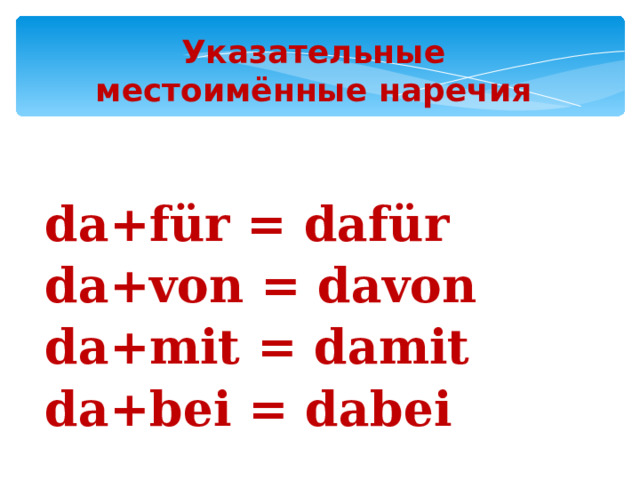
Pronominaladverbien, or pronominal adverbs, are a unique feature of the German language. They are combinations of a preposition and the demonstrative pronouns *da-* or *wo-*. They act as adverbs, but refer to previously mentioned or implied nouns. Think of them as shortcuts to avoid repeating long phrases.
Let's break it down step by step. First, understand the basic components: *da-* and *wo-*.
1. *Da-* + Preposition:
The *da-* prefix refers to something already mentioned or understood. It's like saying "it" or "that" + preposition in English. For example:
- dafür (for it, for that)
- dabei (with it, by it)
- damit (with it, by that)
- davon (of it, from it)
- dazu (to it, to that)
Example: Ich interessiere mich für das Buch. Ich spreche dafür mit meinem Professor. (I'm interested in the book. I'm speaking to my professor *about it*.) Here, *dafür* replaces "für das Buch".
Notice how *dafür* simplifies the sentence and avoids repetition.
2. *Wo-* + Preposition:
The *wo-* prefix introduces a question or refers to something that hasn't been explicitly stated. It's often translated as "what/where + preposition". For example:
- womit (with what)
- wovon (of what, from what)
- worauf (on what)
- wobei (with what, by what)
- wozu (for what)
Example: Womit kann ich Ihnen helfen? (With what can I help you?) Here, *womit* asks about the method or means of assistance.
Important Considerations:
The preposition is usually attached directly to *da-* or *wo-*. However, if the preposition starts with a vowel, insert an *-r-* between the *da-* or *wo-* and the preposition.
- darüber (da + über)
- worüber (wo + über)
These forms are essential for smooth German.
Common Mistakes:
Students sometimes confuse pronominal adverbs with demonstrative pronouns or relative pronouns. Remember: pronominal adverbs act as adverbs, modifying verbs or clauses.
Table Summary:
While not a comprehensive list, this table provides common examples.
Pronominaladverb Meaning Example dafür for it/that Ich bin dafür. (I am for it.) dagegen against it/that Ich bin dagegen. (I am against it.) damit with it/that Er rechnet damit. (He expects it.) davon of/from it/that Ich weiß nichts davon. (I know nothing of it.) worauf on what Worauf wartest du? (What are you waiting for?) womit with what Womit bezahlst du? (What are you paying with?)
Understanding and using Pronominaladverbien enhances your fluency and precision in German. Practice using them in different contexts to master this essential grammatical element. Good luck!