
Nicht Nur Sondern Auch Komma
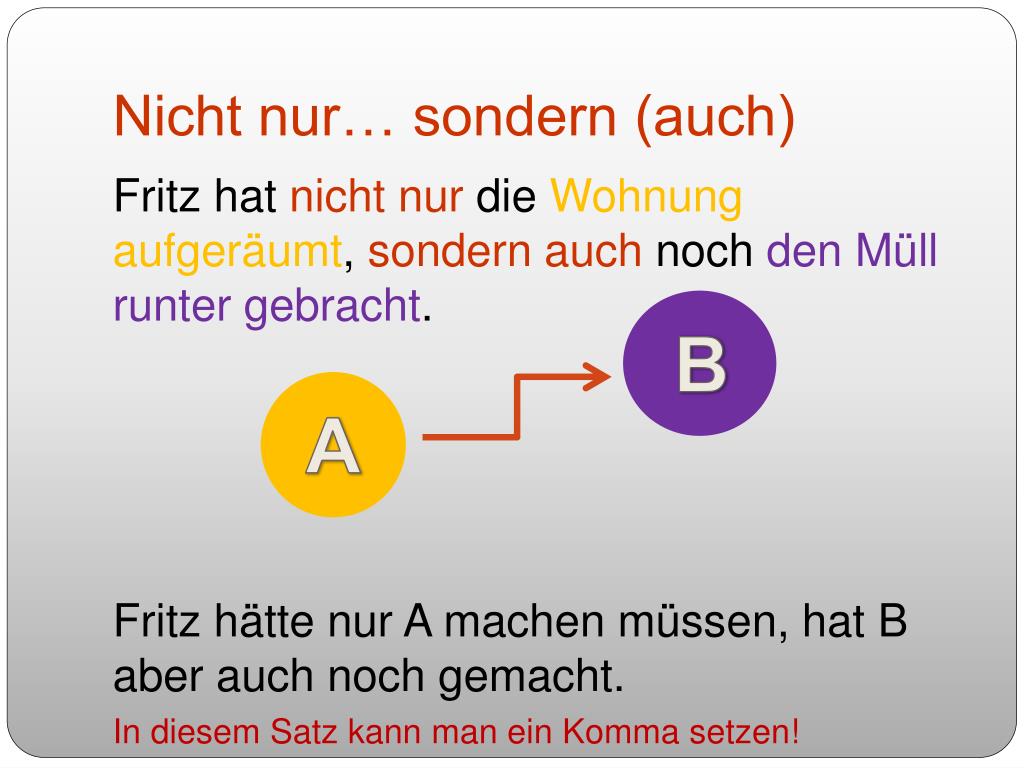
"Nicht nur ... sondern auch": A Comma Conundrum Solved!
Hallo! Let's tackle a tricky grammar point in German: the comma with "nicht nur ... sondern auch". It can seem daunting, but we'll break it down step by step. This guide will help you understand when and where to put that comma, with plenty of examples.
First, let's define the key phrase. "Nicht nur ... sondern auch" translates to "not only ... but also". It's used to emphasize two related points. Think of it as adding an extra layer of information to make your statement stronger. It is often used in daily conversation.
Now, where does the comma go? The comma is usually placed before "sondern". This separates the two parts of the sentence that are being emphasized. Let’s look at a basic example.
Nicht nur ist sie intelligent, sondern sie ist auch fleißig.
This translates to: "Not only is she intelligent, but she is also diligent." Notice the comma comes right before "sondern". This is the general rule, but there are a few exceptions.
The Basic Rule: Comma Before "sondern"
The most common case is when "nicht nur ... sondern auch" connects two main clauses. A clause is a group of words containing a subject and a verb. If both parts of your sentence could stand alone as complete sentences, you need a comma. Let's look at another example.
Nicht nur habe ich meinen Schlüssel verloren, sondern ich habe auch mein Handy vergessen.
This means: "Not only did I lose my key, but I also forgot my phone." Both "Ich habe meinen Schlüssel verloren" and "Ich habe mein Handy vergessen" are complete sentences. That's why we need a comma before "sondern".
Think about it this way: if you could replace "sondern" with "but" in English, you'd likely need a comma in German too. This rule applies most of the time, simplifying things greatly.
When the Comma Isn't Needed
There are situations where the comma is omitted. This happens when "nicht nur ... sondern auch" connects words or phrases within a single clause. If the two parts could *not* stand alone as sentences, you generally don't need a comma.
Sie spricht nicht nur Deutsch sondern auch Englisch.
This translates to: "She speaks not only German but also English." Here, "Deutsch" and "Englisch" are just nouns being connected within the larger sentence. "Deutsch" and "Englisch" on their own aren't complete sentences. Thus, no comma is needed.
Another example. Imagine you're describing a trip.
Wir haben nicht nur gelacht, sondern auch getanzt.
This means: "We not only laughed but also danced." Again, "gelacht" and "getanzt" are verbs that are part of the main clause. The clause “Wir haben gelacht getanzt.” does not have the intended meaning on its own, so a comma is optional.
A good way to test this is to see if removing "nicht nur ... sondern auch" leaves you with a grammatically correct and meaningful sentence. If it doesn't, you probably don't need a comma.
Summary and Key Takeaways
Let's recap the key points. "Nicht nur ... sondern auch" means "not only ... but also." The comma usually goes before "sondern". You need a comma when connecting two main clauses (parts that could be complete sentences on their own). You usually don't need a comma when connecting words or phrases within a single clause.
Understanding this rule will significantly improve your German writing skills. Practice with different examples. And don't be afraid to ask your teacher or a native speaker if you're unsure. With a little effort, you'll master the "nicht nur ... sondern auch" comma rule in no time! Remember to always double-check your work!
Keep practicing, and viel Erfolg beim Deutschlernen!


