Possessive Articles In German Language
Possessivartikel (possessive articles) in German indicate ownership or belonging. They function as determiners, specifying which noun belongs to whom or what. They agree in gender, number, and case with the noun they modify, not with the possessor.
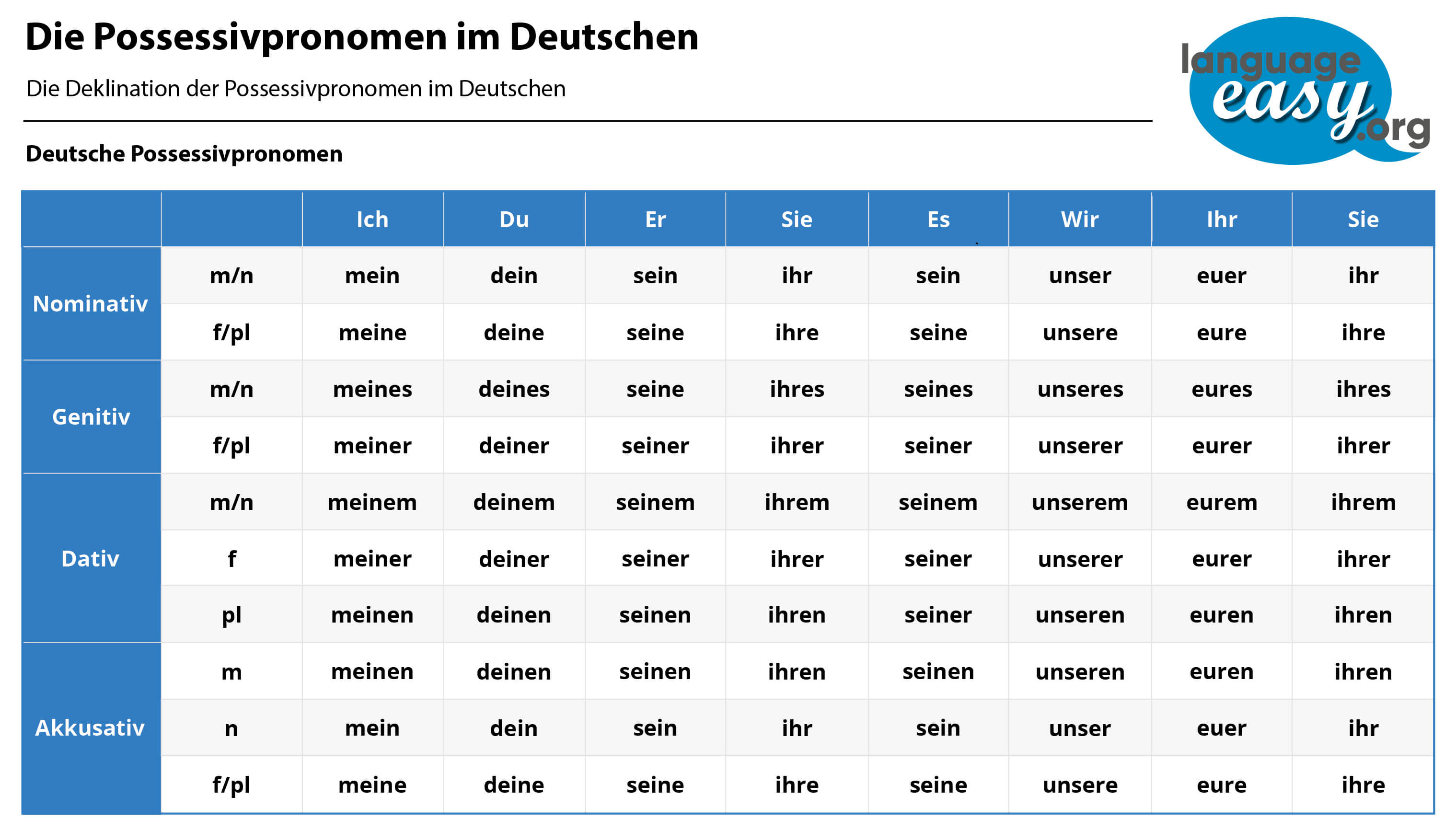
The form of the possessive article changes depending on the gender (masculine, feminine, neuter), number (singular, plural), and case (nominative, accusative, dative, genitive) of the noun being possessed. You must consider these factors to choose the correct possessive article.
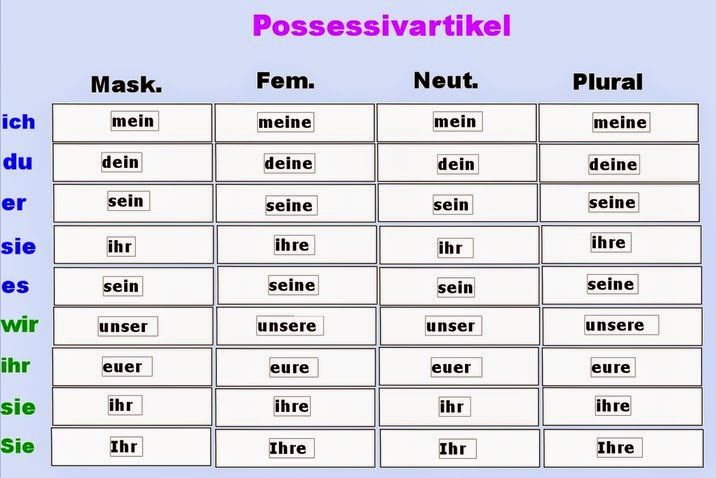
Here are the German possessive articles:
- mein (my)
- dein (your, informal singular)
- sein (his/its)
- ihr (her/their/Your, formal)
- unser (our)
- euer (your, informal plural)
Agreement with the Noun: The possessive article must agree with the noun it describes in gender, number, and case. For example: mein Bruder (my brother - masculine, nominative), meine Schwester (my sister - feminine, nominative), mein Kind (my child - neuter, nominative), meine Kinder (my children - plural, nominative). Notice how "mein" changes to "meine" to agree with the feminine sister or plural children.
Declension: Possessive articles are declined, which means their endings change based on the case of the noun. This is crucial for correct grammar. For instance, in the accusative case: Ich sehe meinen Bruder (I see my brother). The masculine noun "Bruder" in the accusative case changes "mein" to "meinen."
Ihr - Multiple Meanings: The possessive article ihr can mean "her," "their," or "Your" (formal). Context is key to understanding the meaning. Capitalization helps distinguish the formal "Your" (Ihr) from "her" or "their" (ihr).
Euer and eur-: The possessive article euer (your, informal plural) drops the "e" when adding endings. For example, *euer Haus* (your house) becomes *eures Hauses* in the genitive case. This "e" is only dropped in nominative form. The same goes for nominative and accusative. If the word is not masculine or neuter, the "e" is there. e.g. *eure Mutter*.
Here are some examples:
Das ist mein Buch. (That is my book.)
Wo ist deine Tasche? (Where is your bag?)
Understanding and correctly using possessive articles is crucial for forming grammatically accurate sentences in German. Mastering their declension is essential for expressing ownership and relationships clearly.
In real-world applications, correctly using possessive articles allows you to avoid ambiguity and communicate effectively in both spoken and written German. From everyday conversations to formal writing, they are fundamental to expressing possession and building clear, understandable sentences.