Verbs With Dative In German

Hallo! Struggle with the dative case in German? You're not alone. Many learners find it tricky, especially when verbs get involved. It’s not just grammar rules; it's about effective communication and avoiding misunderstandings. Imagine wanting to thank a friend, but accidentally sounding like you're thanking *yourself*! We're going to break down verbs that take the dative case in German, making them less intimidating and more manageable. Let's get started!
Why is the Dative Case Important?
Think of the German cases like roles in a play. Each case (Nominativ, Akkusativ, Dativ, Genitiv) indicates the function of a noun in a sentence. The dative case often indicates the indirect object, the receiver of something. Understanding which verbs require the dative is crucial for constructing grammatically correct and natural-sounding sentences. Forget about just passing tests – this is about real-world conversation!
Without a solid grasp of the dative case, you might end up saying things like "Ich helfe der Mann" (incorrect) instead of "Ich helfe dem Mann" (correct). The first sentence literally means "I help *the* man" in a very direct way, whereas the second indicates that the man is the recipient of your help. It's a subtle difference, but it can completely change the meaning.
What are Dative Verbs?
Dative verbs are verbs that require the dative case for their objects. These verbs dictate that the noun following them takes the dative form. While there are rules and patterns, unfortunately, a good amount comes down to memorization. Don’t worry; we’ll explore effective strategies for that!
It’s tempting to think that you can just rely on word order to convey meaning. However, German word order, while having some flexibility, is heavily reliant on the case system to clarify roles. Ignoring the dative case leads to ambiguity and errors.
Common Dative Verbs and Examples
Let's dive into some of the most frequently used dative verbs. Remember, these verbs *always* require the dative for their direct object (or the equivalent of an indirect object in English).
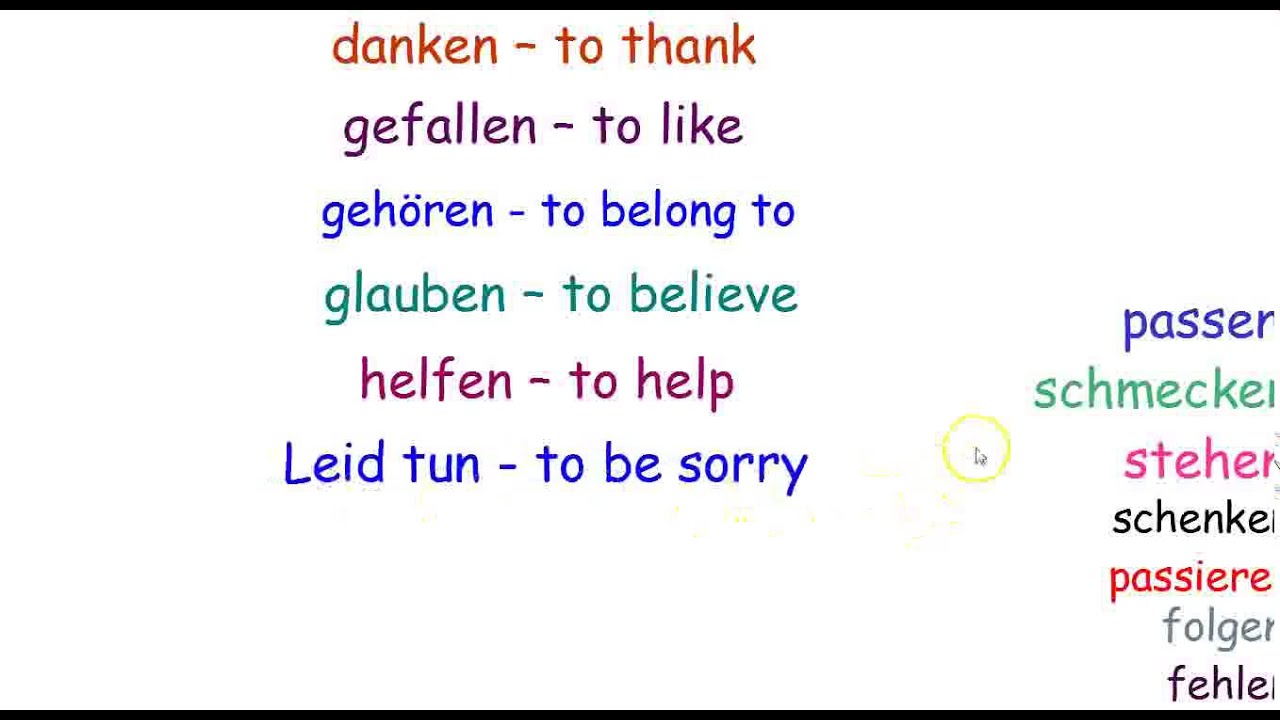
- helfen (to help): Ich helfe dem Mann. (I help the man.) Note that "dem Mann" is dative.
- danken (to thank): Ich danke meiner Mutter. (I thank my mother.)
- gehören (to belong to): Das Buch gehört dem Kind. (The book belongs to the child.)
- passen (to fit): Das Kleid passt ihr gut. (The dress fits her well.)
- schmecken (to taste good to): Der Kuchen schmeckt mir gut. (The cake tastes good to me.)
- glauben (to believe): Ich glaube dir nicht. (I don't believe you.)
- gratulieren (to congratulate): Ich gratuliere dir zum Geburtstag. (I congratulate you on your birthday.)
- antworten (to answer): Ich antworte ihm sofort. (I answer him immediately.)
- begegnen (to encounter, to meet): Ich bin meinem Freund begegnet. (I encountered my friend.)
- folgen (to follow): Ich folge ihm auf Instagram. (I follow him on Instagram.)
Notice how the nouns and pronouns following these verbs are in the dative form. Pay close attention to the articles (der, die, das changing to dem, der, dem) and the personal pronouns (ich, du, er, sie, es changing to mir, dir, ihm, ihr, ihm).
Dative Prepositions: An Important Distinction
It's crucial not to confuse verbs that always require the dative with verbs that can take the dative due to a preposition. For example, the preposition "mit" (with) always takes the dative. So, in the sentence "Ich gehe mit meinem Freund ins Kino" (I'm going to the cinema with my friend), "meinem Freund" is dative because of "mit," not because of the verb "gehen."
This is a common area of confusion. Make sure you can distinguish between verbs that inherently require the dative and those that trigger it because of an accompanying preposition. Learning prepositions and their associated cases is another vital step to mastering German grammar.
Strategies for Mastering Dative Verbs
Okay, so how do we actually learn and remember these pesky verbs? Here are a few effective strategies:
- Flashcards: Create flashcards with the verb on one side and a sentence example using the dative on the other. Focus on the verb *in context*.
- Sentence Mining: When you encounter a new verb, actively search for examples of it being used in sentences. Pay attention to the case of the noun following the verb. Websites like Linguee or Kontext can be very helpful.
- Practice, Practice, Practice: Do exercises specifically designed to test your understanding of dative verbs. Many online resources and textbooks offer these. Focus on error correction – identify *why* you made a mistake.
- Mnemonics: Create memorable associations or rhymes to help you remember which verbs take the dative. This might seem silly, but it can be surprisingly effective. For example, create a little story involving the verbs "helfen, danken, gehören" to link them together.
- Immersion: The best way to internalize these verbs is to use them in real-life conversations. Don't be afraid to make mistakes – that's how you learn! Find a language partner or tutor to practice with.
- Conjugation Tables: While less immediately helpful for dative, knowing verb conjugations in general strengthens the overall understanding of a sentence and helps internalize the meaning.
Don't just passively memorize lists of verbs. Actively engage with the material and find techniques that work best for *your* learning style.
Dealing with Similar-Sounding Verbs
German is full of verbs that sound similar but have different meanings and take different cases. For instance, "gefallen" (to be pleasing to) takes the dative, while "fallen" (to fall) doesn't necessarily. Paying close attention to pronunciation and context is crucial for distinguishing between these verbs.
Another example is "lehren" (to teach), which takes the accusative object, and "gehorchen" (to obey), which takes the dative. The differences are subtle but significant. Keep a running list of these confusing verb pairs and actively practice using them in sentences.
Counterpoints and Common Mistakes
Some argue that the dative case is becoming less important in modern German, with some speakers substituting the accusative case in certain situations. While there's some truth to this, especially in informal speech, mastering the correct usage of the dative is still crucial for formal communication and for understanding written German. Relying solely on accusative can lead to misunderstandings and may be perceived as grammatically incorrect.
One common mistake is using the accusative instead of the dative after verbs that require it. For example, saying "Ich helfe den Mann" (accusative) instead of "Ich helfe dem Mann" (dative). Another mistake is confusing dative prepositions with accusative prepositions. Make sure you know which prepositions trigger which case.
Another error crops up when trying to translate directly from English. In English, we might say "I like him," but in German, "gefallen" is used, which takes the dative: "Er gefällt mir." (He is pleasing to me.) Direct translations often lead to case errors, so focus on understanding the German verb and its associated case requirements.
Solution-Focused Approach
Instead of being overwhelmed by the complexity, focus on incremental progress. Start by mastering a small set of common dative verbs and gradually expand your knowledge. Break down the problem into smaller, more manageable chunks.
Use online resources and apps to practice and test your knowledge. Many websites offer quizzes and exercises specifically designed for dative verbs. Take advantage of these tools to reinforce your learning. Don't be afraid to ask for help from native speakers or teachers. They can provide valuable feedback and insights.
Remember that learning a language is a journey, not a destination. Be patient with yourself and celebrate your progress along the way. Every step you take, no matter how small, brings you closer to fluency.
Real-World Impact
Understanding the dative case isn't just about grammar; it's about connecting with people and expressing yourself effectively. Imagine being able to thank someone sincerely for their help, without accidentally sounding like you're thanking yourself. Or being able to express your preferences accurately, saying "Der Kuchen schmeckt mir gut" (The cake tastes good to me) instead of something grammatically incorrect.
Mastering the dative case opens up a whole new world of communication. It allows you to express nuances and subtleties that would otherwise be impossible. It also demonstrates a higher level of proficiency in German, which can be beneficial in both personal and professional settings.
Think about the joy of understanding German literature and film without relying on subtitles. Or the satisfaction of having meaningful conversations with native speakers. These are just a few of the rewards that come with mastering German grammar.
By investing the time and effort to learn dative verbs, you're investing in your ability to communicate effectively and build meaningful relationships with German speakers. This is a skill that will serve you well throughout your life.
Ultimately, understanding and using verbs with the dative correctly allows you to navigate the German language with confidence and accuracy. It eliminates potential misunderstandings and promotes clear, effective communication, both in spoken and written form.
So, what are you waiting for? Start practicing those dative verbs today! What one dative verb are you going to focus on mastering this week?