Wann Seit Und Wann Seid
The correct usage of "wann," "seit," "und," "wann seid" and "wann seit" in German can be a source of confusion for learners. These words have distinct meanings and grammatical functions, and mistaking them can lead to misunderstandings. This article will provide a comprehensive explanation of each word, highlighting their differences and illustrating their correct usage with examples.
Understanding "Wann"
Wann is an interrogative adverb that translates to "when" in English. It is used to ask questions about time, specifically inquiring about the point in time when something happened, is happening, or will happen. It is a fundamental word in German for forming temporal questions.
Usage of "Wann" in Questions
Wann always introduces a question. The question can be a direct question, using question word order (verb second), or an indirect question, embedded within another clause.
Direct Question:
Wann kommst du? (When are you coming?)
Wann hat der Film angefangen? (When did the movie start?)
Wann wirst du deine Hausaufgaben machen? (When will you do your homework?)
In these examples, the verb follows "wann" directly, indicating the question word order.
Indirect Question:
Ich weiß nicht, wann er ankommt. (I don't know when he is arriving.)
Kannst du mir sagen, wann das Geschäft öffnet? (Can you tell me when the store opens?)
Es ist unklar, wann die Sitzung stattfinden wird. (It is unclear when the meeting will take place.)
In indirect questions, the word order is different. The verb comes at the end of the clause introduced by "wann". This is the standard word order for subordinate clauses in German.
"Wann" vs. "Wenn"
It's important to distinguish "wann" from "wenn," which means "if" or "when" (in the sense of "whenever"). While both relate to time, "wann" is used for specific inquiries about time, while "wenn" introduces conditional clauses or clauses describing repeated actions.
Wann kommst du? (When are you coming? - Asking for a specific time)
Wenn ich Zeit habe, komme ich. (If I have time, I will come.)
Wenn es regnet, bleibe ich zu Hause. (When it rains, I stay home.)
Understanding "Seit"
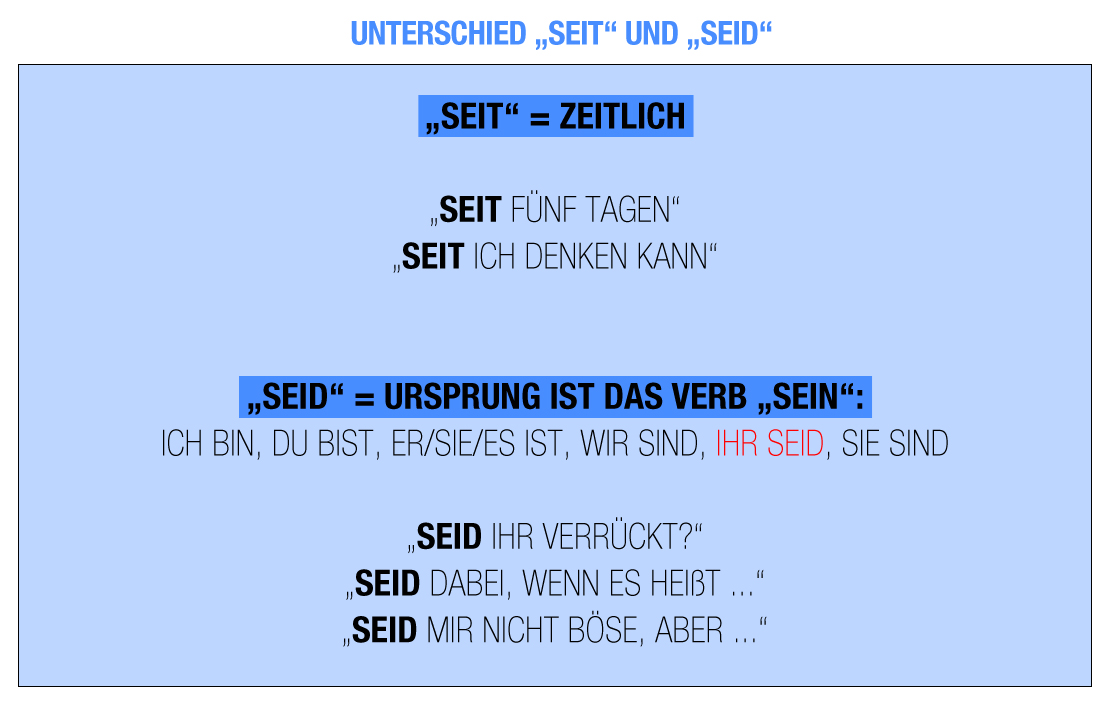
Seit is a preposition that translates to "since" or "for" (when referring to a duration) in English. It is used to indicate the starting point of an action or state that continues up to the present time. It is always followed by the dative case.
Usage of "Seit" to Indicate a Starting Point
Seit introduces a period of time that began in the past and continues into the present.
Seit gestern regnet es. (It has been raining since yesterday.)
Seit 2010 wohne ich in Berlin. (I have lived in Berlin since 2010.)
Seit einer Woche bin ich krank. (I have been sick for a week.)
In these examples, "seit" indicates the beginning of the action (raining, living in Berlin, being sick) and implies that the action is still ongoing.
"Seit" vs. "Ab" and "Vor"
It's crucial to differentiate "seit" from "ab" and "vor". "Ab" means "from" and indicates the starting point of a future action or state, while "vor" means "ago" and refers to a point in the past that is no longer continuing.
Seit Montag arbeite ich hier. (I have been working here since Monday - and I still work here.)
Ab Montag arbeite ich hier. (I will be working here from Monday - starting in the future.)
Vor einer Woche habe ich hier angefangen. (I started here a week ago - and may or may not still be working here.)
"Seit" and Temporal Adverbs
Seit is often used with temporal adverbs like "langem" (for a long time), "kurzem" (for a short time), and "einer Weile" (for a while).
Seit langem habe ich dich nicht gesehen. (I haven't seen you for a long time.)
Seit kurzem wohnt er in dieser Stadt. (He has been living in this city for a short time.)
Seit einer Weile geht es mir besser. (I have been feeling better for a while.)
Understanding "Und"
Und is a conjunction that translates to "and" in English. It connects words, phrases, or clauses of equal grammatical rank. It is one of the most common and fundamental conjunctions in German.
Usage of "Und" to Connect Words and Phrases
Und can link nouns, adjectives, verbs, adverbs, and other parts of speech.
Brot und Butter (Bread and butter)
Groß und stark (Big and strong)
Lesen und schreiben (Reading and writing)
Schnell und präzise (Quickly and precisely)
Usage of "Und" to Connect Clauses
Und can also connect independent clauses. When connecting clauses, the word order in each clause remains unchanged.
Ich gehe ins Kino, und du gehst nach Hause. (I am going to the cinema, and you are going home.)
Sie ist müde, und sie möchte schlafen. (She is tired, and she wants to sleep.)
Es regnet, und der Himmel ist grau. (It is raining, and the sky is gray.)
"Und" vs. Other Conjunctions
It's important to distinguish "und" from other conjunctions like "aber" (but), "oder" (or), and "denn" (because), which introduce different relationships between the connected elements.
Ich bin müde, und ich gehe ins Bett. (I am tired, and I am going to bed.) - Shows a connection of similar ideas.
Ich bin müde, aber ich kann nicht schlafen. (I am tired, but I cannot sleep.) - Shows a contrast.
Möchtest du Kaffee oder Tee? (Would you like coffee or tea?) - Presents a choice.
Ich bin zu Hause geblieben, denn es hat geregnet. (I stayed home, because it was raining.) - Provides a reason.
The Non-Existence of "Wann Seit" and Addressing "Wann Seid"
The phrase "wann seit" is grammatically incorrect and has no meaning in German. It attempts to combine the interrogative adverb "wann" (when) with the preposition "seit" (since/for), which cannot logically occur together in that order. A question asking "when" something has been ongoing "since" a certain point doesn't make sense.
The confusion might arise because learners try to directly translate phrases from other languages, but German grammar requires a different structure.
However, the phrase "wann seid" *can* be grammatically correct, but only in specific contexts. It's the question form of "wann" (when) followed by the conjugated form of the verb "sein" (to be) in the second-person plural "ihr" (you - plural)."
Understanding "Wann Seid"
"Wann seid" is a question asking "When are you (plural)?" or "When will you (plural) be?". The context is crucial to understanding the meaning. It is crucial to remember the plural *ihr*.
Wann seid ihr fertig? (When will you (plural) be finished?)
Wann seid ihr angekommen? (When did you (plural) arrive?)
Wann seid ihr bereit? (When will you (plural) be ready?)
In these examples, "seid" is the conjugated form of "sein" that corresponds to the pronoun "ihr" (you - plural). Therefore, the question is addressed to a group of people.
Common Mistakes and How to Avoid Them
The most common mistake is confusing "seid" (you are/will be - plural) with other forms of "sein" or misusing "wann seit" entirely. Here's how to avoid these errors:
- Always check the context: Are you addressing a group of people ("ihr") or a single person ("du" or "Sie")? This will determine the correct form of "sein."
- Remember "wann seit" is incorrect: Instead, rephrase the sentence to use "wann" and "seit" separately, if appropriate, or choose a different construction altogether.
- Practice conjugation: Regularly practice conjugating the verb "sein" in all its forms (ich bin, du bist, er/sie/es ist, wir sind, ihr seid, sie/Sie sind).
- Pay attention to word order: In direct questions, the verb (including the conjugated form of "sein") follows the question word ("wann").
Real-World Examples and Data
Analyzing online German texts and social media posts reveals that misuse of "wann," "seit," and "seid" is common among learners. Search engine data can also indicate the frequency of incorrect searches for "wann seit," highlighting the confusion. While precise statistical data is difficult to obtain without large-scale linguistic analysis, anecdotal evidence from language learning forums and teacher observations confirms that these are persistent areas of difficulty.
For instance, a search on Google Trends for "wann seit" shows a recurring pattern of searches, indicating that people are actively looking for this (incorrect) phrase. This underscores the need for clear and accessible explanations of the correct usage.
Conclusion and Call to Action
Mastering the correct usage of "wann," "seit," "und," and "wann seid" is essential for effective communication in German. While "wann seit" is incorrect and should be avoided, "wann seid" is valid when addressing a group of people ("ihr") and asking about a future or past state of being. Remember the key differences: "wann" asks about a specific time, "seit" indicates a duration starting in the past and continuing to the present, and "und" connects elements of equal grammatical rank.
To improve your understanding and avoid mistakes, I encourage you to:
- Practice using these words in different sentences. Write your own examples and ask a native speaker or teacher to review them.
- Pay close attention to the context in which these words are used. Read German texts, listen to German conversations, and analyze how native speakers employ these terms.
- Focus on verb conjugation, particularly the verb "sein." A solid understanding of verb conjugation is crucial for using "seid" correctly.
- If you encounter difficulty, don't hesitate to seek clarification from reliable resources such as grammar books, online dictionaries, or language teachers.
By diligently practicing and paying attention to detail, you can overcome the challenges associated with these words and enhance your overall fluency in German. Good luck!