Was Haben Wir Heute Für Datum
"Was haben wir heute für Datum?" is a German question. It directly translates to "What date do we have today?" in English. It's a very common and useful phrase to learn when speaking German.
Understanding the Parts
Let's break down the question word by word:
- Was: This means "what". It's used to ask about a thing or an idea. For example: "Was ist das?" (What is that?)
- Haben: This means "have". It's the conjugated form of the verb "haben" (to have) used with "wir" (we).
- Wir: This means "we". It indicates the subject of the verb, in this case, "we" are having something.
- Heute: This means "today". It specifies the time frame – the current day. Think of it like saying "today" in English.
- Für: This is a preposition. In this context, it's best understood as "for" or "as" in relation to the date. It connects "Datum" to the rest of the sentence.
- Datum: This means "date". This is the core information you're asking for. It refers to the day, month, and year.
So, putting it all together, the question is literally asking: "What have we today for date?" The English translation, "What date do we have today?" is a more natural way to phrase it.
How to Answer
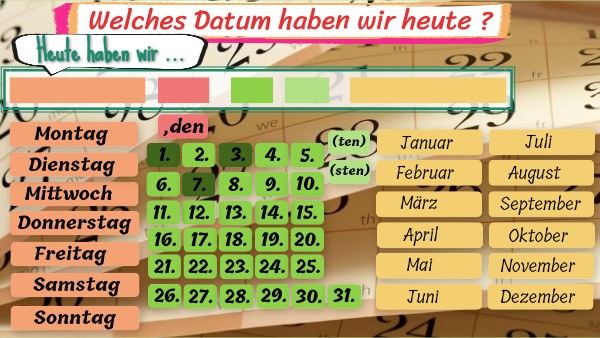
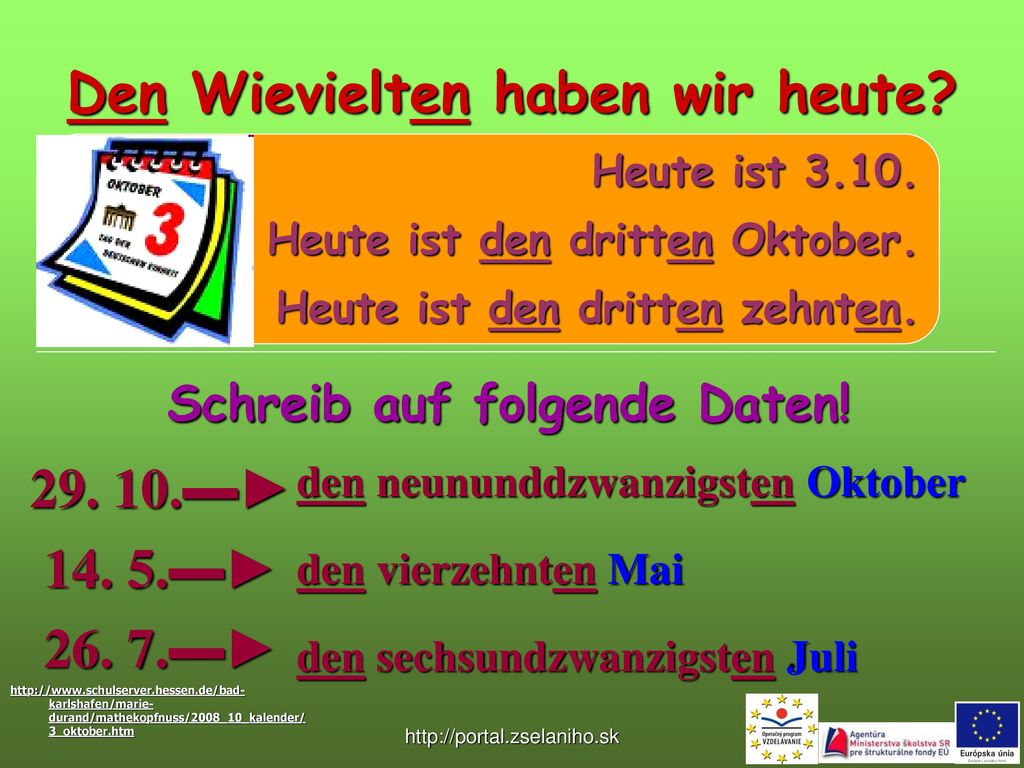
To answer the question "Was haben wir heute für Datum?", you need to provide the date in German. German date format is typically: day. month year. The day and month are written as numbers.
Here are some examples:
- If today is January 1st, 2024, you would say: "Heute ist der 1. Januar 2024." (Today is the 1st of January 2024.)
- If today is March 15th, 2024, you would say: "Heute ist der 15. März 2024." (Today is the 15th of March 2024.)
Notice the word "der" before the day number. This is the masculine definite article (the). You use it because, grammatically, the day number is considered masculine in this context. It's important to remember this detail.
Key Vocabulary
To give the date, you'll also need to know the months in German:
- Januar (January)
- Februar (February)
- März (March)
- April (April)
- Mai (May)
- Juni (June)
- Juli (July)
- August (August)
- September (September)
- Oktober (October)
- November (November)
- Dezember (December)
Also, knowing the numbers is crucial. Especially numbers one through thirty-one to give the day!
Using it in Conversation
"Was haben wir heute für Datum?" is a great conversation starter. You can use it in many everyday situations:
- Asking a colleague at work.
- Checking the date with a friend.
- Confirming the date at a doctor's appointment.
It's a polite and direct way to get the information you need. Pair it with a friendly "Guten Tag!" (Good day!) or "Hallo!" (Hello!) to be even more polite.
Practice Makes Perfect
The best way to learn this phrase is to practice using it. Try asking yourself the question every day and answering it aloud. You can also practice with a friend who is learning German. The more you use the phrase, the more comfortable you will become with it. Remember to focus on pronunciation and grammatical accuracy. Viel Glück! (Good luck!)