Was Ist Das Gegenteil Von

Was ist das Gegenteil von? This question asks: "What is the opposite of?" It's a very common question when learning German, or any language, to expand vocabulary.
Understanding "Gegenteil"
Gegenteil means opposite in German. It refers to something that is completely different from another thing. Think of it as the complete reverse or contrary of something.
Let's break it down:
- Gegen: This part means "against" or "opposite".
- Teil: This part means "part".
So, Gegenteil is like the "opposite part" or the "against part" of something. It's the thing that's furthest away in meaning.
How to Find the "Gegenteil"
Finding the Gegenteil depends on what you're talking about. Here are some examples:
- Adjectives: These describe qualities. The opposite of an adjective is often another adjective.
- Nouns: These are things or people. The opposite might be another thing or person that has a contrasting role or characteristic.
- Verbs: These are actions. The opposite is often doing the reverse action or not doing something.
Examples of "Gegenteile"
Here are some common German words and their Gegenteile:
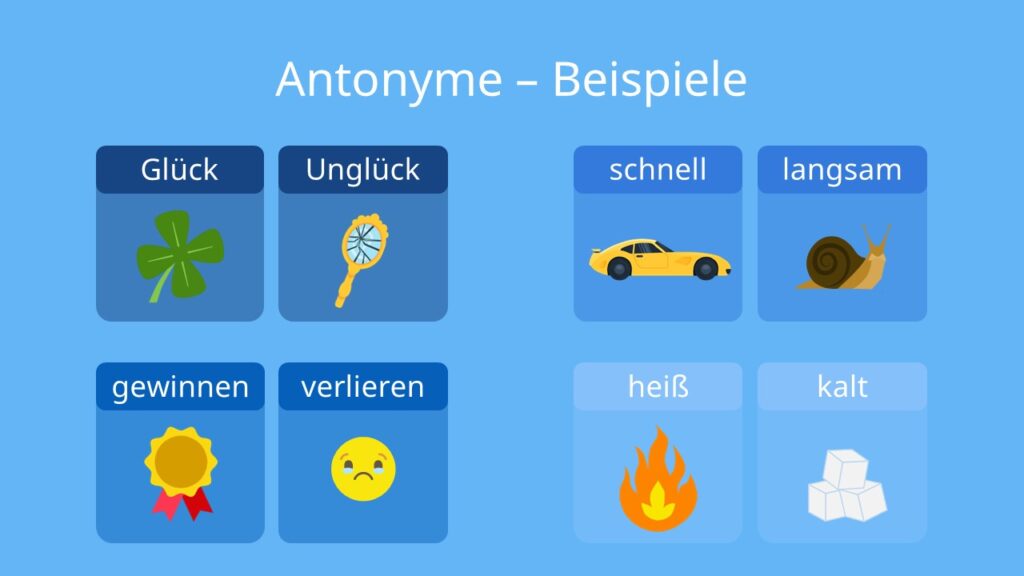
- Heiß (hot) - Kalt (cold)
- Groß (big) - Klein (small)
- Schnell (fast) - Langsam (slow)
- Gut (good) - Schlecht (bad)
- Lieben (to love) - Hassen (to hate)
- Anfangen (to begin) - Aufhören (to stop)
- Tag (day) - Nacht (night)
- Freund (friend) - Feind (enemy)
Notice how each pair represents a direct contrast. Something can't be both hot and cold at the same time. Usually!
Using "Was ist das Gegenteil von?" in a Sentence
Here's how you would use the question in a sentence:
Was ist das Gegenteil von hell? (What is the opposite of bright?) The answer would be dunkel (dark).
Another example:
Was ist das Gegenteil von fragen? (What is the opposite of to ask?) The answer would be antworten (to answer).
Important Considerations
Sometimes, finding the perfect Gegenteil isn't straightforward. Some words have multiple meanings, so the opposite depends on the context.
For example, the word "laut" can mean "loud" or "according to".
- If "laut" means "loud", the Gegenteil is "leise" (quiet).
- If "laut" means "according to", the Gegenteil might be "entgegen" (contrary to) or "trotz" (despite).
Context is key!
Why Learning "Gegenteile" is Useful
Knowing Gegenteile is a great way to improve your German:
- Expands vocabulary: You learn two words at once!
- Improves understanding: You grasp the nuances of word meanings.
- Enhances communication: You can express yourself more precisely.
So, next time you're learning a new German word, ask yourself: "Was ist das Gegenteil von...?" It's a helpful habit!